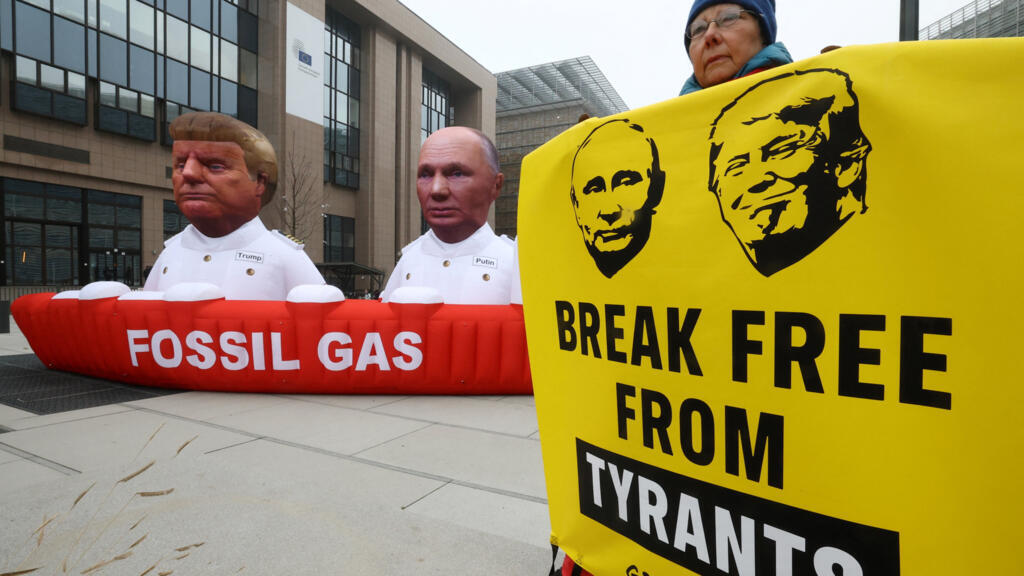
European Union countries on Monday gave their final approval to ban Russian gas imports by late 2027, making their vow to cut ties with their former top supplier legally binding, nearly four years after Moscow's full-scale invasion of Ukraine.
Ministers from EU countries approved the law at a meeting in Brussels on Monday, although Slovakia and Hungary voted against and Bulgaria abstained.
Hungary said it would challenge the law at the European Court of Justice.
The ban was designed to be approved by a reinforced majority of countries, allowing it to overcome opposition from Hungary and Slovakia, who remain heavily reliant on Russian energy imports and want to maintain close ties with Moscow.
Under the agreement, the EU will halt Russian liquefied natural gas imports by end-2026 and pipeline gas by 30 September, 2027.
The law allows that deadline to shift to 1 November, 2027, at the latest, if a country is struggling to fill its storage caverns with non-Russian gas ahead of winter.
Russia supplied more than 40 percent of the EU's gas before 2022. That share dropped to around 13 percent in 2025, according to the latest available EU data.
But some EU countries continue to pay Moscow for oil, pipeline gas and liquefied natural gas, contradicting their efforts to support Ukraine and restrict funding to Russia's wartime economy.
EU backs plan to drop Russian gas by 2027 as reliance continues to fall
Law bans new gas deals
Last month, the five biggest EU importers spent €1.4 billion on Russian energy, mostly on gas and LNG, data from the non-profit Centre for Research on Energy and Clean Air showed. Hungary was the biggest buyer, before France and Belgium.
The EU imposed sanctions on Russian seaborne oil in 2022, but never proposed sanctions on gas imports, which would require unanimous approval from all 27 EU countries.
The EU law prohibits companies from signing new Russian gas deals and will require those with existing contracts to terminate them to comply with the ban.
For existing contracts, imports under short-term deals signed before 17 June 2025, will be banned on 25 April 2026, for Liquefied natural gas (LNG) and 17 June for pipeline gas. Long-term contracts must be phased out by the final deadlines.
Companies could face financial penalties of up to 3.5 percent of total global annual turnover for failure to comply.
The European Commission plans to also propose legislation in the coming months to phase out Russian pipeline oil, and wean countries off Russian nuclear fuel.
Ukraine's Energy Minister Denys Shmyhal welcomed the EU's 2027 ban on Russian gas imports, saying in a statement on Monday that independence from Russian energy "is, above all, about a safe and strong Europe."
Wind power commitment
Meanwhile, also on Monday, Germany, France, the UK and Denmark were among nine countries which signed an agreement pledging to turn the North Sea into the "world's largest clean energy reservoir".
The EU's Commissioner for Energy and Housing, Dan Jorgensen, said that the agreement was a "very clear signal to Russia".
"No more will we let you blackmail member states of the European Union and no more will we help indirectly fund the war in Ukraine," Jorgensen said.
Signed at the third North Sea summit in Hamburg, it pledges to deliver 100 gigawatts (GW) of offshore wind power capacity through large-scale joint projects. That would be enough to power roughly 100 million homes.
The commitment to boost cross-border collaboration is part of a goal agreed by North Sea countries in 2023 to have 300 GW of offshore wind capacity by 2050.
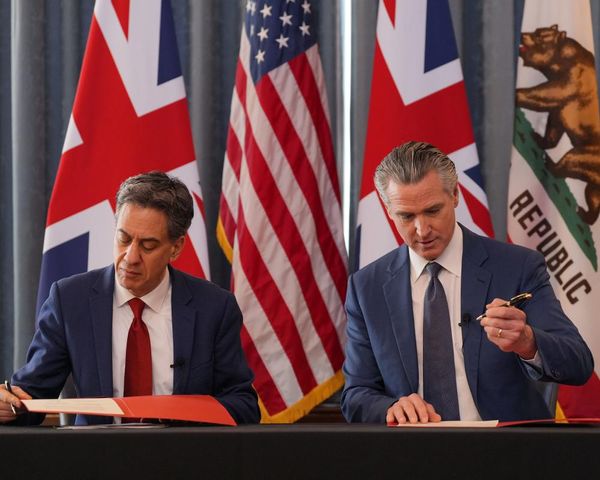
In response to recent comments from US President Donald Trump branding wind farms "losers", British Energy Secretary Ed Miliband said that "offshore wind is for winners".
Wind farms are "absolutely critical for our energy security" to provide "homegrown, clean energy that we control", he said, adding that this energy is not under "the control of the dictators and the petro-states".
(with newswires)