An alleged South American drug camp bombed with the help of the U.S. military and celebrated by Defense Secretary Pete Hegseth appears to have actually been a humble dairy farm, according to a new report.
On March 6, Pentagon spokesperson Sean Parnell announced the U.S. had “executed targeted action” against “narco-terrorism networks” in Ecuador in partnership with the country’s security forces.
In a video he posted online, an explosion can be seen ripping through a remote, riverside patch of land, sending thick columns of smoke into the air.
“We are bombing Narco Terrorists on land as well,” Hegseth boasted, referring to the U.S. military’s strikes on alleged drug boats in the Caribbean Sea and Pacific Ocean — a campaign that has killed at least 144 people.
But a new investigation by The New York Times indicates that the bombed‑out site had no connection to drug trafficking and appears to have, in fact, been a small dairy and cattle farm, whose owner is now infuriated.
Reporters from the outlet visited the site — located along the Colombia-Ecuador border — earlier this month, where residents recounted the explosive operation.
The farm’s employees told the Times that Ecuadorian service members landed by helicopter on March 3, interrogated the workers, beat them with their guns and set several structures on fire. Three workers, who were not named, said they were “choked” and subjected to “electrical shocks” before being released.
Three days later, Ecuadorian military helicopters returned and unleashed explosives on the farm’s remaining structures, villagers said. It was this incident that was captured on video and later posted by U.S. officials.
Officials from the Latin American country said the property had been used by an armed group to conceal weapons and served as a training ground for “about 50 drug traffickers.”
Ecuador, a country of nearly 20 million people, is a major exporter of cocaine, and local drug gangs have driven a surge in violence in recent years. Armed Colombian groups also operate near the nation’s mountainous border.
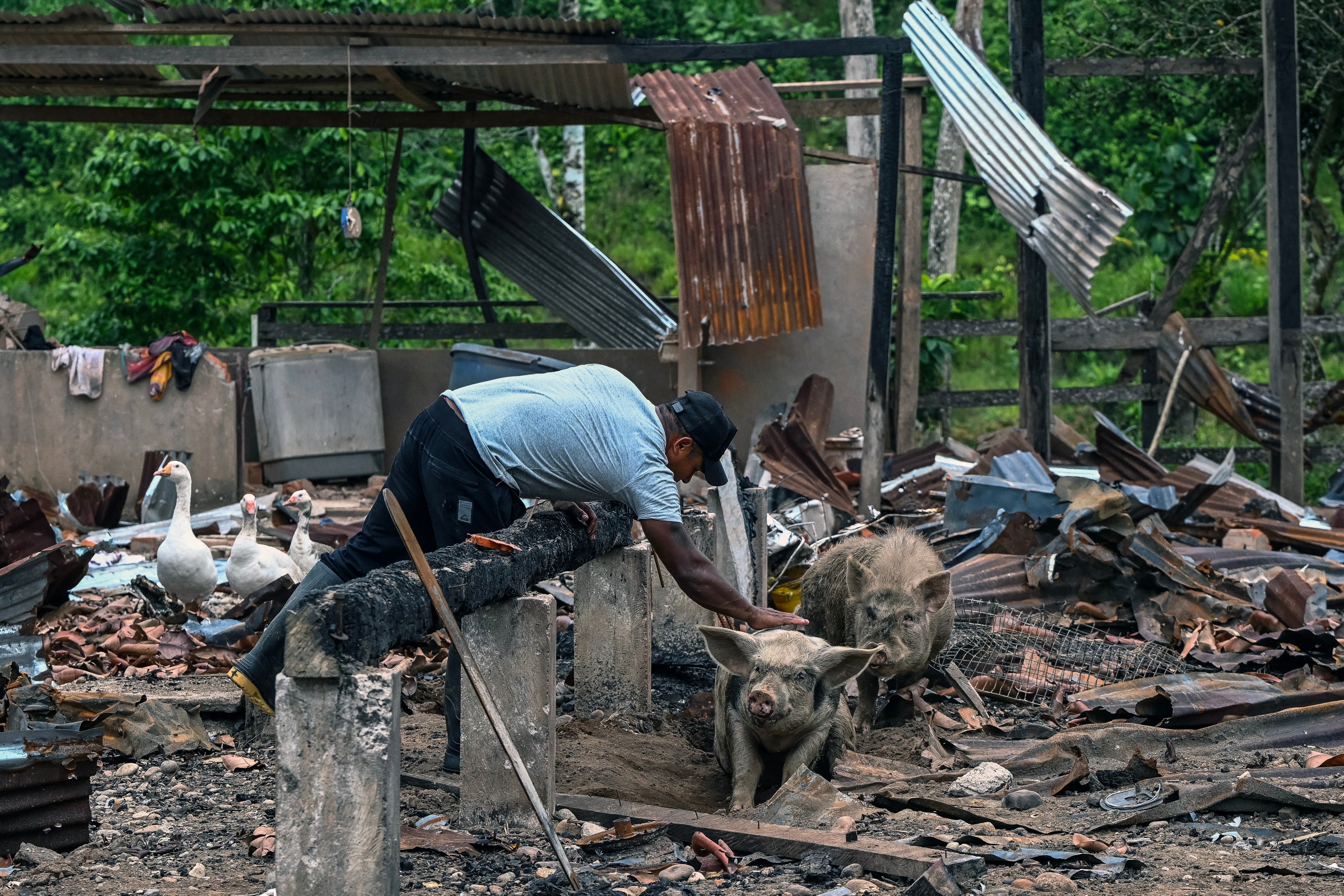
But residents, including the property’s owner, said the farm had no involvement in illegal activity and added that the strikes were part of a broader campaign in which several abandoned homes were burned down.
“It’s an outrage,” the farm’s owner, a 32-year-old father of two, told the Times. “It’s a lie that 50 people trained here. Where are they going to train? Out here in the open? There’s no logic.”
He said he bought the 350‑acre property about six years ago and has since raised roughly 50 cows there. “Everywhere you look there are animals: the cows I milk, the calves, the horses,” he said.
While holding back tears, he claimed that the military operation had destroyed equipment sheds, a cheese outpost and a chicken coop.
In an attempt to seek justice, the Alliance for Human Rights, a group of organizations in Ecuador, filed a complaint with the United Nations and the country’s government.
“There isn’t a single public official who has come to verify what happened,” said María Espinosa, a human rights lawyer, told the Times.
Under the leadership of President Trump and Secretary Hegseth, the Department is uniting partners across the Western Hemisphere to detect, disrupt, and destroy designated terrorist organizations that fuel violence and corruption.
— Sean Parnell (@SeanParnellASW) March 6, 2026
We commend President Noboa, the Government of… pic.twitter.com/vlhSB4BGKO
While Ecuadorian officials said soldiers found weapons and “evidence of illicit activity” at the site, they have not released that evidence to the public.
According to a press release posted by the Ecuadorian government, the country’s security forces relied on American "intelligence and support” to conduct the operation.
Pentagon spokesperson Kingsley Wilson told the Times that the March 6 strike was carried out “jointly” with Ecuadorian authorities in furtherance of their goal of combating “cartel networks” that “threaten the stability of our hemisphere.”
“Due to operations security, we will not discuss specific tactics or targeting details,” she added.
The operation highlights the aggressive, maximalist foreign policy that has come to define Trump’s second term thus far.
Since returning to office, he's greenlit military strikes across multiple nations— including Nigeria, Somalia, Syria, Yemen and Iraq. In January, U.S. forces swooped into Venezuela, seizing then-President Nicolas Maduro and extraditing him to New York. In late February, full-scale war erupted against Iran, which has now ground on for more than three weeks.