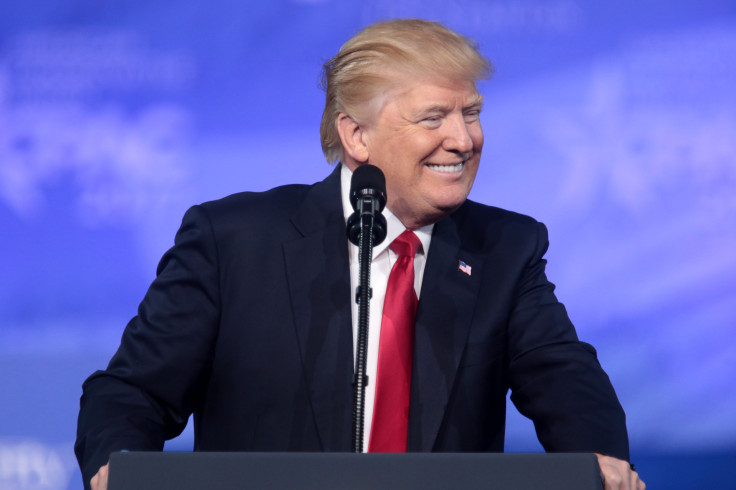
Donald Trump's mental health is under fresh scrutiny after a psychologist claimed that the 79-year-old President is 'mentally ill and cognitively deteriorating,' citing his late‑night social media posting as evidence of possible sundowning and mania.
Mounting concern among some mental health professionals and critics over Trump's public behaviour as he inches towards 80 and continues to dominate Republican politics. While Trump has long faced accusations of erratic conduct, the latest claims focus less on his political choices and more on what clinicians say may be a visible neurological decline, played out in real time on his social media feed.
In his rapidly deteriorating clinical condition, Donald Trump is “grooming” Americans for a nuclear conflict, Dr. John Gartner claims.
— The Daily Beast (@thedailybeast) May 21, 2026
https://t.co/9VXgOgq23Z
Psychologist Says Donald Trump Is 'Declining In Plain Sight'
Dr John Gartner, a psychologist and former Johns Hopkins University professor, told The Daily Beast Podcast that the signs are now so overt he believes a layperson could spot them.
'Anybody who has eyes, ears, and a brain... and hasn't drunk the Kool-Aid or been bitten by a MAGA zombie, can see for themselves that this person is transparently mentally ill and cognitively deteriorating,' Gartner said, arguing that debate over whether professionals can diagnose from afar has become almost beside the point. In his view, 'you don't even need to be a doctor' to see that something is wrong.
It is a deliberately provocative claim, not one universally accepted. Gartner has been sounding the alarm for some time, previously telling the same outlet in April that Trump had been 'showing signs of frontotemporal dementia since 2019.' Later that month, he criticised Trump's apparent 'magical thinking,' a trait he linked to psychosis, suggesting the President had drifted further from reality as the years have gone on.
Those are heavy labels, and Gartner is not speaking from a clinical examination room. His assessment rests on public appearances and Trump's prolific online activity. Still, he insists the pattern is clear enough to warrant public concern, not just private speculation among specialists.
Late-Night Posting, Sundowning And A Red Button
Gartner and others have zeroed in on Trump's social media behaviour in recent weeks, arguing that both the timing and the nature of his posts are now as telling as their political content. Trump, they say, is often online throughout the night, sharing a rapid succession of messages, including false claims and inflammatory attacks, punctuated by AI‑generated imagery and videos.
'First of all, he's up at all hours of the night, all night... posting all of these lies and crazy stuff,' Gartner said. 'The pace of it that someone would be up all night tweeting in and of itself is a clinical indicator of some kind of either mania or sundowning, and I think in his case it's actually a combination of both.'
In clinical language, 'sundowning' is a term more commonly associated with forms of dementia, where confusion and agitation worsen later in the day. Mania, by contrast, sits in the bipolar spectrum and is characterised by decreased need for sleep, racing thoughts and impulsive behaviour. Gartner is careful enough not to declare a formal diagnosis, but casual he is not. He effectively invites the public to read Trump's timeline as a rough medical chart.
One particular post troubled him more than most. Amid a stream of AI‑generated images at the weekend, Trump shared a depiction of himself pressing a large red button. On its face, it was another piece of internet theatre. To Gartner, it represented something much darker.
He argued that Trump was 'grooming' Americans to accept scenarios that once would have been unthinkable, including nuclear conflict. 'Let me tell you something about Trump. He never, ever jokes. Can you remember a single funny joke he's ever told? Because I can't. And he doesn't bluff, either,' Gartner said, contending that the President uses repetition of extreme imagery to normalise it. In his words, Trump 'is grooming us for nuclear war,' driven by what Gartner labelled 'malignant narcissism' and a sense of power through 'destruction and domination.'
The language is stark, and some will find it hyperbolic. Others will see it as overdue plain speaking about a man who once had control of the US nuclear arsenal and may yet again.

Trump World Dismisses Warnings On Cognitive Decline
Asked to respond, Trump's team offered a flat rejection of any suggestion of cognitive decline. White House spokesperson Davis Ingle told The Daily Beast that 'President Trump is the sharpest and most accessible President in American history who is working nonstop to solve problems and deliver on his promises, and he remains in excellent health.'
Trump himself has long leaned on cognitive testing as proof he is mentally fit, repeatedly boasting that he has passed three assessments, specifically the Montreal Cognitive Assessment, since his second inauguration. He frames this as evidence of superior acuity. Some experts hear something else.
Former U.S. Iran envoy Rob Malley says the chances of a deal depend less on technical nuclear details than on President Donald Trump’s mindset.
— Drop Site (@DropSiteNews) May 18, 2026
“You need to ask a psychologist,” Malley told Al Jazeera, saying Trump’s position changes “hour by hour.” Malley also explained Trump’s… pic.twitter.com/LpnSU3YeQm
Dr Henry David Abraham, professor of psychiatry emeritus at Tufts University School of Medicine, told the outlet that the sheer number of tests in a short period could be a red flag. 'If you have one MoCA, that's like taking your temperature,' he said. 'If a temperature is okay, you don't come back every 10 minutes and take another temperature. But if it's not okay, then you want to see where it's going.'
Nothing in these public exchanges amounts to a confirmed diagnosis, and no independent medical records have been released to substantiate either Gartner's warnings or Trump's insistence that he is in 'excellent health.' For now, everything rests on what can be seen and heard, and what different observers choose to make of it. Until qualified clinicians with direct access speak on the record, all such claims should be taken with a grain of salt.