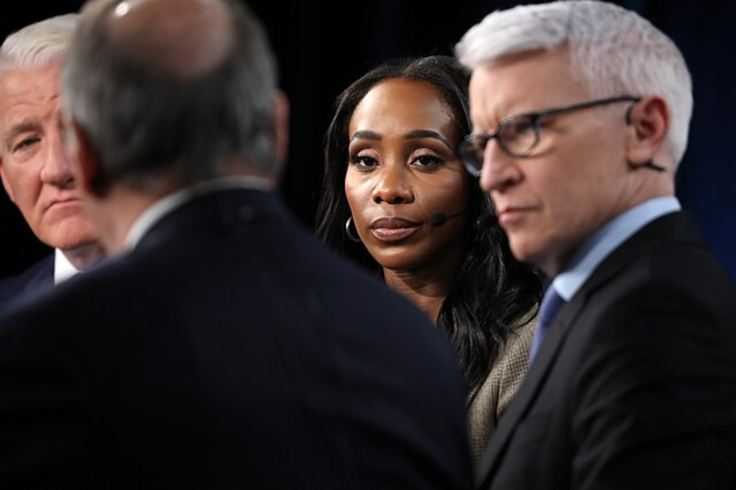
CNN anchor Abby Phillip has criticised President Donald Trump for expanding the Monroe Doctrine following the capture of Venezuelan leader Nicolás Maduro and subsequent threats against Cuba, Mexico and Colombia, saying he is 'declaring himself King of the World'. The comments came as Trump issued new threats against Cuba, Mexico, and Colombia.
During a panel discussion, Phillip pointed to the 3 January raid in Venezuela and the president's subsequent rhetoric as evidence of an alarming pattern. She challenged Trump's assertion that only his own morality limits his presidential powers on the world stage, questioning what accountability remains when a president answers solely to himself. Trump has coined the term 'Donroe Doctrine' to describe his approach, claiming his administration has 'superseded' the original 19th-century policy 'by a lot'.
Phillip unpacked the president's aggressive foreign policy stance during CNN Saturday Morning Table for Five, pointing to the 3rd January raid that captured Maduro as well as Trump's threats to take over multiple nations as evidence of an alarming pattern. The anchor
'King of the World' With No International Accountability
'Just 10 days into the new year, Donald Trump seems to be channelling his inner Leonardo DiCaprio and declaring himself the "king of the world"', Phillip stated during the Saturday morning broadcast. She outlined how Trump has invoked the Monroe Doctrine to justify not only the Venezuela operation but also potential military action across Latin America.
'If it's not clear yet, Trump says that the only thing limiting his powers on the world stage is, quote, his own morality', Phillip said. 'And to top it all off, he says the US doesn't need international law. That is a whole lot of the Don-roe doctrine, as he would put it. Where does that leave us if the president doesn't think that he's accountable to anyone but himself?'
New York Post correspondent Lydia Moynihan defended Trump's actions, arguing they were 'in line with what the Monroe Doctrine has stated for hundreds of years.' Phillip pushed back, suggesting the Founding Fathers would likely agree that the president should be accountable to the people, not his own interests.
Trump Issues Direct Threats to Multiple Nations
Following the Venezuela raid, Trump issued explicit warnings to several Latin American countries during appearances on Air Force One and at Mar-a-Lago. 'Colombia is very sick, too, run by a sick man who likes making cocaine and selling it to the United States, and he's not going to be doing it very long', Trump told reporters aboard Air Force One on Sunday. When asked whether the US would pursue a military operation against Colombia, Trump answered: 'It sounds good to me.'
The president also warned that Cuba was 'ready to fall', citing the island nation's economic dependence on Venezuelan oil. 'Cuba now has no income. They got all of their income from Venezuela, from the Venezuelan oil. They're not getting any of it', Trump said.
Trump further threatened Mexico, saying the country needed to 'get their act together' regarding drug cartels. 'We're going to have to do something. We'd love Mexico to do it, they're capable of doing it, but unfortunately the cartels are very strong in Mexico.' Trump declared.
International Condemnation and Regional Response
The governments of Brazil, Chile, Colombia, Mexico, Uruguay and Spain issued a joint statement expressing 'profound concern' over the US military actions. 'These actions contravene fundamental principles of international law, particularly the prohibition on the use or threat of force', the statement read. 'They constitute an extremely dangerous precedent for peace and regional security and endanger the civilian population.'
Colombian President Gustavo Petro condemned the US intervention and responded to Trump's threats on X, saying 'Stop slandering me, Mr. Trump'. Petro called on Latin America to unite against the US, warning that the region risks being 'treated as a servant and slave'.
Mexican President Claudia Sheinbaum rejected the US actions, stating that 'the history of Latin America is clear and compelling: Intervention has never brought democracy'.
Just a friendly reminder about the US and the Kingdom of Denmark: We are close allies and should continue to work together as such. US security is also Greenland’s and Denmark’s security. Greenland is already part of NATO. The Kingdom of Denmark and the United States work… https://t.co/CboKnlKgJL
— Jesper Møller Sørensen 🇩🇰 (@DKambUSA) January 4, 2026
Why the 'Donroe Doctrine' Matters
Trump's revival and expansion of the Monroe Doctrine represents a significant shift in US foreign policy. President Theodore Roosevelt previously expanded the doctrine in 1904 with the Roosevelt Corollary, asserting the US right to exercise 'international police power' in Latin America. This expansion helped set the stage for repeated US military interventions.
Gretchen Murphy, a professor at the University of Texas and author of Hemispheric Imaginings, said Trump's reference to the doctrine was in line with how his predecessors used it to police Latin American nations 'to make sure their governments acted in US commercial and strategic interests.' Trump's aggressive approach has raised concerns about whether international law remains a binding constraint on American power.