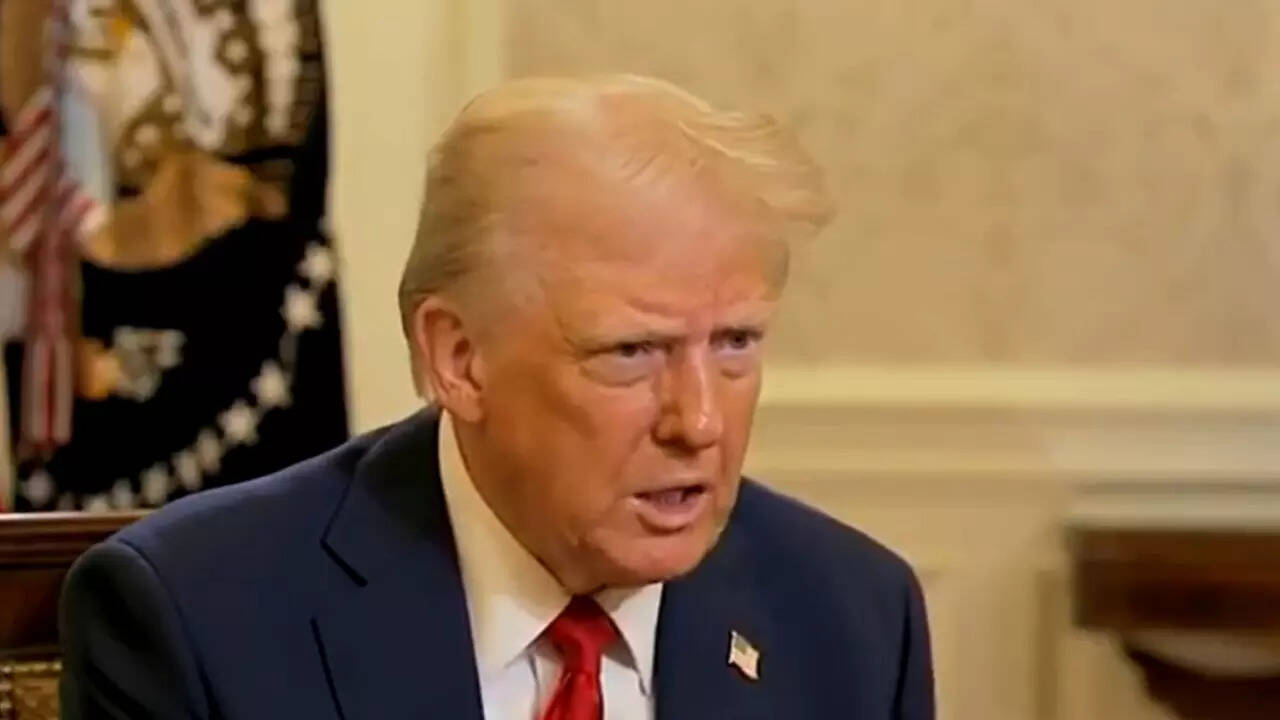
US President Donald Trump on Monday said that the situation with Iran remains “in flux,” saying he has deployed a “big armada” to the region even as he believes Tehran genuinely wants to strike a deal.
White House officials said an attack was still on the table after Trump came close to ordering a strike on regime targets in Iran earlier this month over the killing of thousands of protesters. Instead, he delayed the decision while also moving military assets to the region, though the protests were largely suppressed.
Axios reported that Trump had not made a final decision. He likely held more consultations this week and was presented with additional military options.
Those options were enhanced by the arrival of an aircraft carrier strike group to the region. The USS Abraham Lincoln entered CENTCOM's area of responsibility on Monday.
In the interview with Zxios, Trump mentioned his decision to dispatch the Lincoln.
"We have a big armada next to Iran. Bigger than Venezuela," Trump said.
He declined to discuss the options presented to him by his national security team, or which one he preferred.
At the same time, he said diplomacy remained an option. "They want to make a deal. I know so. They called on numerous occasions. They want to talk."
Some more hawkish members of Trump's circle urged him to enforce his own red line after he promised to help the protesters and punish the regime.
Others questioned what bombing Tehran would actually achieve, and were more intrigued by the idea of using the regime's weakness to push for a deal.
US officials said any deal would have to include the removal of all enriched uranium from Iran, a cap on Iran's stockpile of long-range missiles, a change in Iran's policy of supporting proxies in the region and a ban on independent uranium enrichment in the country.
The Iranians said they were willing to talk but did not signal any willingness to accept those terms.
Trump claimed that prior to the 12-day war last June, Iran's "big force of missiles" meant it could have launched a damaging surprise attack on Israel.
By giving Israel a green-light to attack first, Trump claimed he had prevented such a scenario.
"They would have attacked...but that first day [of the war] was brutal for them. They lost their leaders and many of their missiles," Trump said.
"If there was a different president Iran would have the nukes, and they would have attacked first," he added.
Prior to the 12-day war, US and Israeli intelligence assessed that if Iran decided to sprint for a nuclear weapon it would take two weeks to enrich enough weapons-grade uranium and four to six months to produce a crude nuclear device.
Iran's nuclear facilities were badly damaged by US and Israeli strikes, though the status of its uranium stockpile was not fully clear.
The US military was bracing for an order from Trump.
In addition to the Lincoln, the military sent more F-15 and F-35 fighter jets, more refuelling tankers, and additional air defence systems to the region.
CENTCOM commander Admiral Brad Cooper visited Israel on Saturday to coordinate military plans and potential joint defensive efforts to counter an Iranian attack against Israel, sources said.