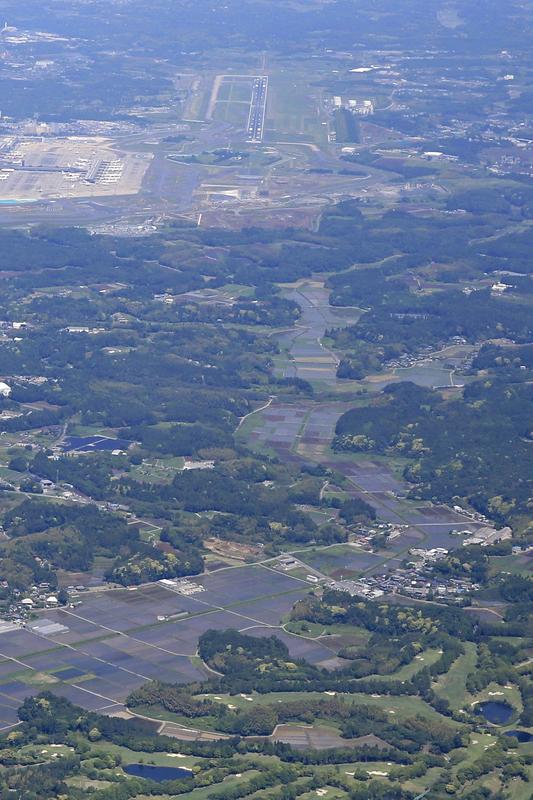
NARITA, Chiba -- May 20 marked 40 years since Narita Airport opened. While the airport initially faced violent opposition, it has developed into one of Japan's main international gateways and is used by more than 40 million people annually.
Now the air hub faces the challenge of boosting its international competitiveness, a mission it will tackle based on an agreement reached by the central government, local municipalities and other bodies to "strengthen the functions of the airport" (see below).
"Forty years is a stepping stone for us," said Makoto Natsume, president of airport operator Narita International Airport Corp. (NAA), at a regular press conference on April 26. "We must look farther ahead so we can fulfill our role as the main entrance to Japan."
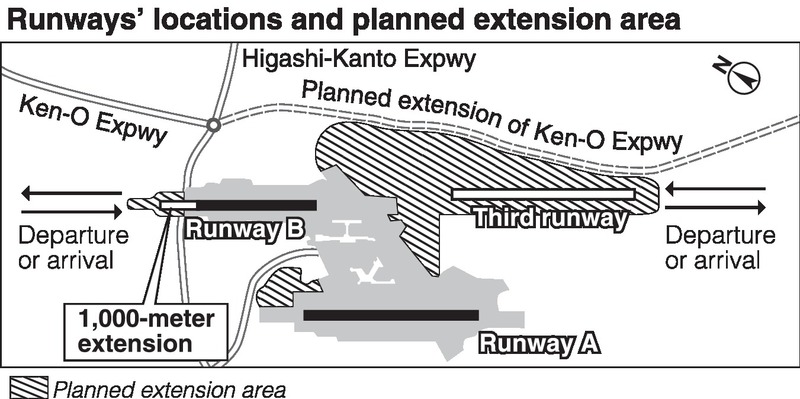
In March, the central government, the Chiba prefectural government, nine municipal authorities and NAA agreed to strengthen the functions of the airport. Construction of a third runway, expanded operating hours and other steps will increase the airport's annual arrival and departure slots to 500,000, up by 200,000 from now, and make it possible to accept 75 million people each year. "This major project is almost the same as constructing a new airport," Natsume said.
The third runway is scheduled for completion within 10 years. An NAA official said that strengthening the airport's functions will enable it to meet more than 90 percent of the operational needs of airlines. Expansion plans for Narita Airport are taking flight.
Preferred slots full
In fiscal 2017, Narita Airport set record highs for both passengers (40,939,895) and total number of takeoffs and landings (252,447). Ninety-eight Japanese and international airlines use the airport, with flights to 133 cities in 43 nations and territories.
At present, Narita has 300,000 annual arrival and departure slots, with 48,000 remaining to be filled. However, a major Southeast Asian airline executive said, "We want to fly more often [to Narita], but it's hard to do that."
The main cause of this frustration is the restriction on when flights can land and take off at the airport. Many major airports operate around the clock, but flights to and from Narita start at 6 a.m. and end at 11 p.m., in principle. This time restriction was a promise made to local authorities when the airport opened because of the impact of aircraft noise on the lives of nearby residents.
This restriction has affected major airlines and also been an impediment to attempts by budget carriers to start services or increase flights. Low-cost airlines use early-morning and late-night flights to offer cheaper ticket prices. Narita's daytime and evening time slots, when demand is high, are completely full.
Dominance slipping
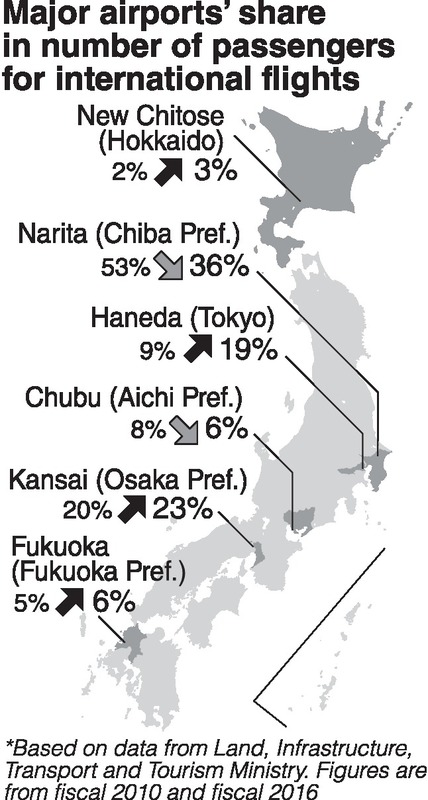
This "lack of convenience" has also eroded Narita's standing among Japan's 28 airports. In fiscal 2010, 53 percent of passengers coming to Japan on international flights went through Narita, but this figure declined to 36 percent in fiscal 2016. The resumption of international services from Tokyo's Haneda Airport was a factor in this decline. Haneda's share during the same period jumped from 9 percent to 19 percent, while Kansai Airport's increased from 20 percent to 23 percent.
In 2016, Haneda expanded daytime slots for flights to and from the United States. Consequently, in October that year, All Nippon Airways switched some of its direct New York and Chicago flights from Narita to Haneda. In April 2017, Japan Airlines also resumed operating some flights on its New York route at Haneda. Narita's distance from central Tokyo is also a drawback.
Tapping Asia's growth
In his policy speech in January, Prime Minister Shinzo Abe said, "We will expand takeoff and landing slots at Haneda and Narita airports to 1 million, the highest level in the world."
According to NAA, London has 1.04 million slots at its five airports, including Heathrow, while New York's three airports have 1.19 million. A figure of 1 million would put Narita and Haneda on par with other major airports, but at present their combined capacity is 750,000 slots.
Narita is also undeniably inferior to key airports in Asia. China's Hong Kong International Airport, Shanghai Pudong International Airport, South Korea's Incheon Airport and Singapore's Changi Airport all handle between 50 million and 70 million passengers annually, eclipsing Narita in this respect.
According to the Land, Infrastructure, Transport and Tourism Ministry, solid economic growth in the Asia-Pacific region has been behind demand for international air travel rising by 9 percent on average over the past five years. This growth is expected to continue in the years ahead.
Amid these conditions, the government has set a target of attracting 40 million visitors to Japan in 2020 and 60 million in 2030. Strengthening Narita's functions, and ensuring it has a complementary relationship with Haneda, will be necessary for achieving these goals.
"Expanding Narita is the only option for increasing capacity at the airports serving the Tokyo metropolitan area, so the agreement to strengthen the functions of Narita is a crucial step," said Masahiko Kurono, 76, the first NAA president and now chairman of the Japan Transport Research Institute.
"This plan moved forward based on calls from local authorities that the third runway was needed, rather than it being forced down their throats by the government. The agreement was decided after many discussions and explanatory meetings for residents. This process reflects lessons learned from the bitter fighting over Narita during its early days, which is an asset created during our history. Neighboring municipalities need to make the vicinity of the airport easy for young people to live in, and consider how to build communities that harness the benefits the airport's function strengthening plan will bring."
From conflict to coexistence
Even now, Narita Airport can be called "uncompleted."
There is land totaling 2.9 hectares where construction is scheduled that has yet to be purchased. This includes land owned by farmers opposing expansion of the airport and small plots measuring one tsubo (about 3.3 square meters) whose ownership is shared by anti-airport activists.
In July 1966, the Cabinet decided the airport would be constructed in the Sanrizuka district of Narita, Chiba Prefecture. The following month, the Sanrizuka-Shibayama United Opposition League against Construction of the Narita Airport was formed and has continued activities to resist the airport's construction and expansion.
Its activities were violent at times, and a clash with police over the government's forcible land expropriation caused several deaths and injuries. In March 1978, extremist activists stormed and occupied the control tower four days before the airport was due to start operations. This incident delayed the airport's opening for about two months.
The atmosphere surrounding the airport gradually changed between 1991 and 1994 thanks to the "Symposium for Narita Airport Issues" and the "Narita Airport Roundtable Conference." The government recognized the errors of its heavy-handed tactics and opened the door to the airport and nearby communities coexisting by taking steps including abandoning the forcible expropriation of land.
The 2,180-meter second runway started operating provisionally in 2002. The period between the airport's opening and 2002 has been dubbed "the lost 24 years." The second runway was extended northward to avoid unacquired land to its south, and in October 2009 it finally reached its originally planned length of 2,500 meters.
For the local area, the airport has also changed into a facility with which it can coexist and both sides can benefit. As of November 2017, the airport had 43,271 employees, many of whom live in nearby municipalities. Some of these local governments have flourished thanks to fixed property tax regarding the airport.
The plan to strengthen the airport's functions will enlarge the airport's area by about 1,000 hectares to about 2,400 hectares. About 1,100 households in four municipalities are expected to move due to this expansion and noise issues. Many of these residents indicated they intend to cooperate with the plan, and steps will get under way to purchase their land and find suitable relocation sites for households that move.
With the airport expected to require about 70,000 employees when the expansion is completed, finding enough workers is also shaping up as an issue to be addressed.
(From The Yomiuri Shimbun, May 18, 2018)
-- Plan to strengthen the functions of Narita Airport
An agreement reached in March to strengthen Narita Airport's international competitiveness. Its three main pillars are building a 3,500-meter third runway; extending the second runway by 1,000 meters northward to 3,500 meters; and extending the airport's operating hours. The first runway's hours of usage will be extended by one hour (to operate from 6 a.m. to midnight) by the 2020 Tokyo Olympics and Paralympics. After the third runway comes into service, the airport's operating hours will be extended to 5 a.m. to 12:30 a.m. the next day. Each runway will choose from two sets of operating hours, and areas under the flight routes for each runway will receive seven hours of quiet time each day.
Read more from The Japan News at https://japannews.yomiuri.co.jp/