A court in Tizi Ouzou, in eastern Algeria, on Wednesday announced a ten-year sentence in the appeal trial of French sports journalist Christophe Gleizes, accused among other things of "glorifying terrorism". Arrested in May 2024, he has been detained since his trial in June, when he was originally sentenced to seven years in prison.
"The accused did not come to Algeria to do journalistic work but to commit a hostile act," said the prosecutor, who also requested a fine of 500,000 Algerian dinars (approximately €3,300).
Christophe Gleizes, 36, a contributor to the French magazines So Foot and Society, imprisoned in Algeria since the end of June, had previously asked the court for leniency, stating that he should have applied for a journalist visa instead of a tourist visa to come and report.
Called to the stand at his appeal trial on Wednesday morning, 36-year-old Gleizes asked for leniency, acknowledging that he had made "many journalistic errors despite [his] good intentions."
A contributor to the French magazines So Foot and Society, Gleizes also admitted that he should have been aware that some of his contacts were linked to an organisation classified as terrorist in Algeria.
"I beg your mercy so that I can be reunited with my family," he said in an emotional testimony.
Tourism visa
Gleizes had travelled to Algeria to write an article about the country's most successful football club, Jeunesse Sportive de Kabylie (JSK), based in Tizi Ouzou, 100 km east of Algiers.
French NGO Reporters Without Borders (RSF) said he was arrested on 28 May 2024 and placed under judicial supervision, for "entering the country with a tourist visa, for 'glorifying terrorism' and 'possession of publications for propaganda purposes that harm the national interest'".
The justice system accused him of having been in contact with an offical from the JSK, who was also one of the leaders of the Movement for the Self-Determination of Kabylie (MAK), which was classified as a terrorist organisation by Algerian authorities in 2021.
Algeria sentences French sports journalist to seven years behind bars
According to RSF, the initial exchanges between the two men "took place well before this categorisation by the Algerian authorities" and "the only exchange that occurred in 2024 concerned the preparation of his report" on JSK, "something Christophe Gleizes has never hidden."
Gleizes "has no business being in prison; his only crime is having done his job as a sports journalist and loving Algerian football," Thibaut Bruttin, director general of RSF told the press in October.
During the initial trial in June, Gleizes' French lawyer, Emmanuel Daoud said that there had been "a complete misunderstanding of the journalistic profession," by Algerian authorities.
"We had to explained to the judges that a journalist does not engage in politics," that he "is not an ideologue," "not an activist," Daoud told France Inter radio.
The lawyer insisted however on his respect for the "independent and sovereign" Algerian justice system and refuted accusations circulating in France that the journalist was "being held hostage".
He stressed that Gleizes had been able to receive visitors, had access to his criminal file, and consulted with his lawyers.
Support campaigns
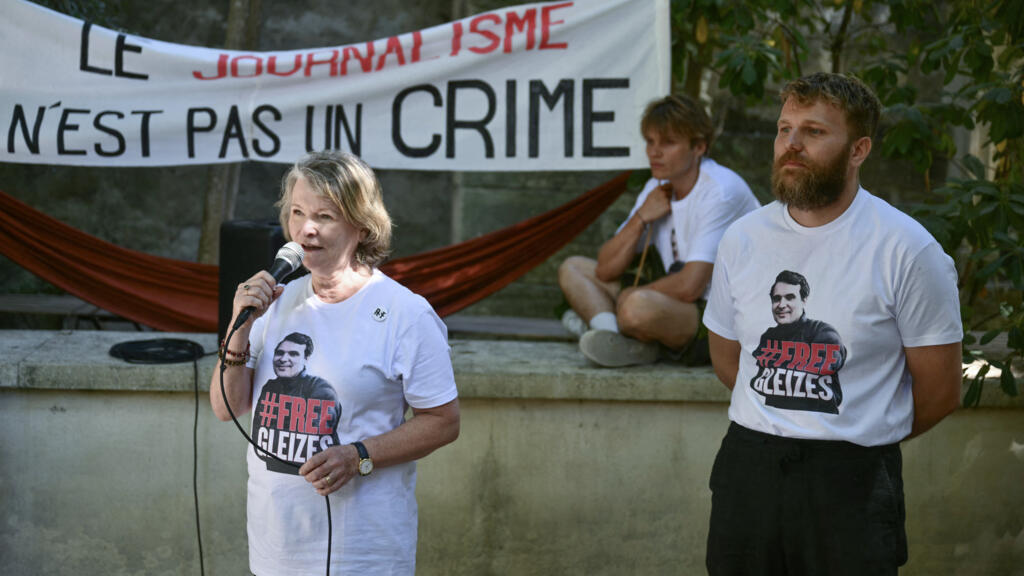
In September, RSF launched a petition and an campaign in support of Gleizes and called on football clubs to raise awareness of Gleizes' imprisonment by making statements before matches.
"Support for Christophe Gleizes is a grassroots movement of all those who love journalism and those who love sport," Bruttin said.
At the end of November, nine media organisations published a petition, calling for Gleizes' release, stating that the"freedom of the press cannot be held hostage".
They reiterated that "a reporter who interviews a sports official is not complicit in their positions: they are doing their job."
They added that "diplomatic tensions must never lead to imprisonment, especially of journalists", referring to the recent tensions between France and Algeria.
Franco-Algerian writer Boualem Sansal calls for 'reconciliation' between France, Algeria
Indeed at the time of his arrest, Gleizes found himself caught in the midst of a diplomatic crisis between France and its former colony, marked in particular by the withdrawal of the two ambassadors and the reciprocal expulsions of diplomats.
Tensions escalated with France's recognition of Moroccan sovereignty over Western Sahara in July 2024, where Algeria backs the pro-independence Polisario Front.
Last November, Algerian authorities arrested the Franco-Algerian writer Boualem Sansal, who spent a year in prison on national security charges before being pardoned last month.
Relations also took a dive when in January this year, when Algeria refused to take back an Algerian influencer deported from France, accused of inciting violence on social media.