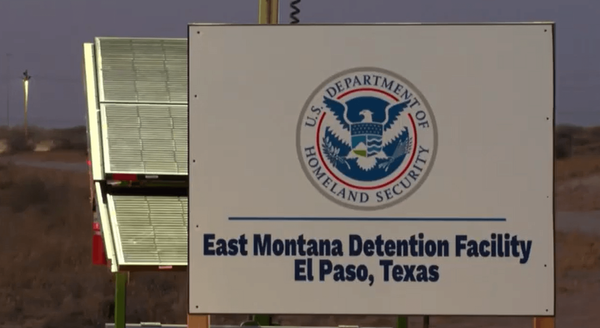

In the Trump administration’s war on immigrants—adults and children alike—South Texas is a nexus.
Immigration and Customs Enforcement (ICE) agents have arrested 33,583 people in the San Antonio and Harlingen areas of responsibility between Trump’s first day in office and March 10 of this year, according to the agency’s data. In Minneapolis, three ICE agents who shot people have a Rio Grande Valley connection. The Department of Homeland Security plans to put hundreds of miles of buoys in the Rio Grande, 17 of those miles being in the Valley, to allegedly stop people from attempting to cross. Texas’ only licensed Hindi, Urdu, and Punjabi court interpreter was detained in Harlingen’s airport in March, which also happens to be where ICE flies many of its deportees out of the United States.
And the Dilley detention center, officially the Dilley Immigration Processing Center or previously the South Texas Family Residential Center, which sits about an hour southwest of San Antonio, was reopened by the Trump administration after ICE (during the Biden administration) had closed it in 2024. Liam Conejo Ramos and his father, infamously detained in Minneapolis, were sent to and released from there earlier this year.
Daniel Hatoum is a San Antonio-based senior supervising attorney for the Texas Civil Rights Project. The Texas Observer spoke with him in early June about family detention, how habeas corpus cases became de facto immigration law, Senate Bill 4, and what mass deportation does to society.
TO: Dilley detention center has become a common name right now in the immigration news lexicon, but most people may not know what it is, besides its name and that Liam Ramos and his father were detained there. The Texas Civil Rights Project is part of an effort with the Texas Immigration Law Council called Operation Clear Out Dilley, which is an attempt to help release the 50 or so children in the facility. Can you describe who’s held there, and under what legal authority? What does daily life look like?
It’s a family detention facility, which means it’s a facility where parents and their children are held together. These types of facilities have been used because the detention of children is a very fraught exercise. Children could face additional harms that adults may not be subject to when it comes to detention. During the Bush administration, there was a concerted effort to try to detain families out of a fear that people might be coming over the border with children and using those children as a way to avoid detention.
The first big family detention center is actually still a detention center today: It’s the Hutto Detention Facility in Taylor. There was a lot of litigation about that. The government did not do well in that litigation, and that facility ultimately had to stop detaining children.
During the Obama administration, what ended up happening is that they implemented family detention as well to try to detain folks, and they opened two facilities, the Karnes family detention facility was the first one, they also opened the Berks [County] facility in Pennsylvania, which is very small, then they needed an even bigger facility, and that’s when Dilley was opened. That one holds the most amount of family detention beds that we’ve seen.
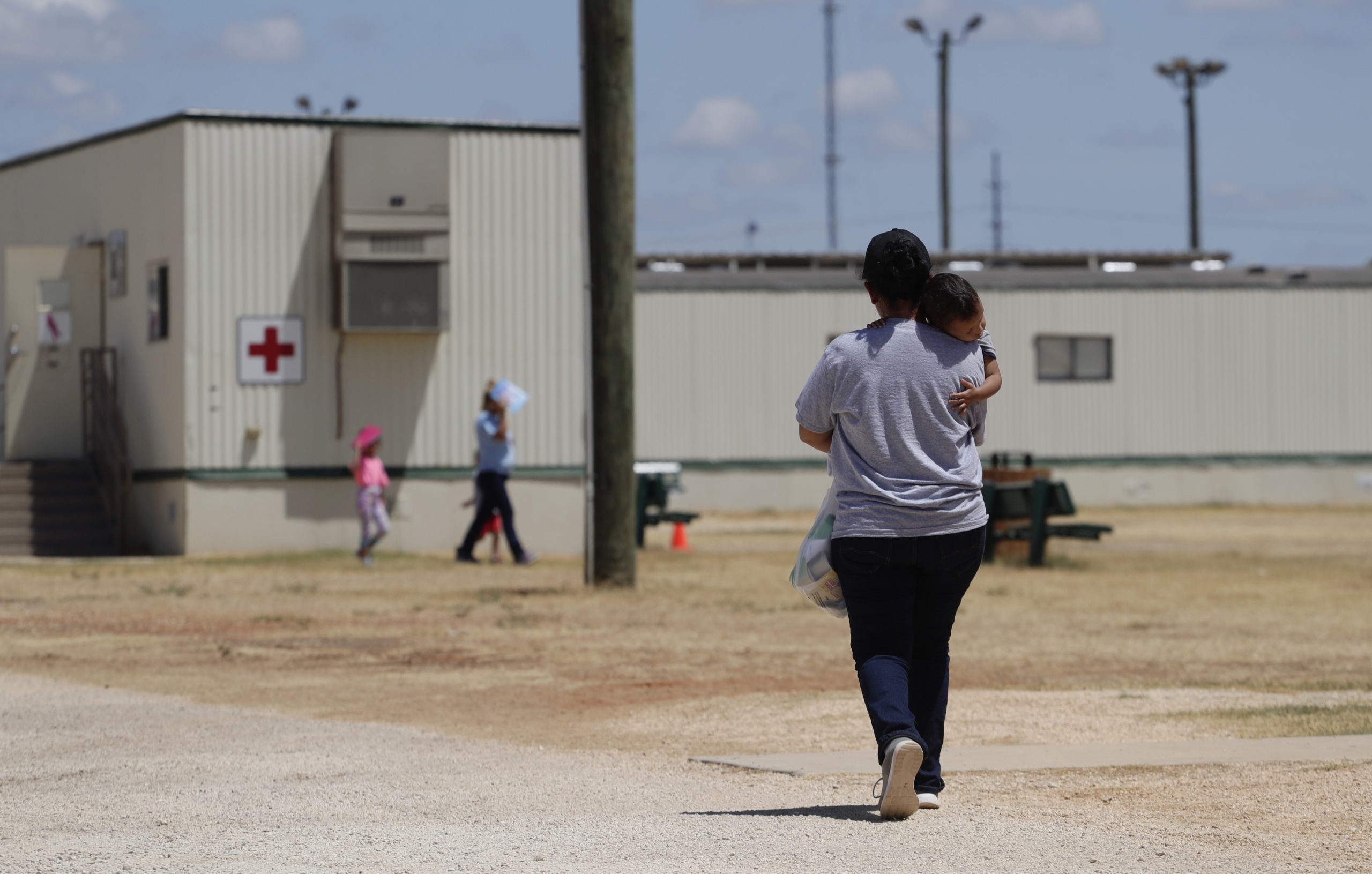
It’s a former natural gas camp that has all these trailers, so when you hear [Congressman] Joaquin Castro talk about it, I believe he refers to it as the “Dilley trailer prison.” That’s a pretty accurate description. … So, who’s there? Well, it’s parents and their children, but the age of the children doesn’t exempt them from detention there. So, tender-age children can go to family detention centers. Children who are infants can be in a family detention center. There have been high-profile cases of babies that have gone to family detention centers. Our client in the “Ms. Z” case, which we took on last year, was a six-year-old with a history of leukemia.
Food is rotten in Dilley. There’s no other way to put it. That’s what’s happening. I guess the only other way to put it is worm-filled, because it’s often filled with worms. It’s not child-appropriate. Remember, when you have children who are as old as 16 months, 18 months, they have very specific food needs, and we’ve heard multiple reports from many folks in the detention facility that those needs were not met.
The other thing that’s worth pointing out is that the American Academy of Pediatricians has indicated, since 1997, when the first big case about children’s detention came out, that any time in detention for a child is extremely harmful. It causes children to suffer; it creates long-term developmental problems. … Family detention center has this feedback [loop] where parents are put in a position of helplessness because they can’t get what their children need because the administration will not give them what they need, and the children are watching their parents be helpless, the parents are watching their children suffer and they’re only spiraling worse.
The administration has claimed all sorts of new authorities to detain people when it previously wouldn’t have … people who have received parole to be in the country, who received permission to be here, who were released on their own recognizance, who the government said, “You are not a flight risk, you are not a danger. We will not detain you,” and the government takes that back and says, “Actually, who cares? We’re going to detain you.”
So, under what authority? Their whims, and the fact that there are people in charge right now who think they can get away with it.
How did habeas corpus become the legal remedy sought out by people in detention centers? Before last year, there were few of these cases in federal courts. Now there are nearly 40,000 active habeas cases in the United States, 9,000 of which are in Texas.
It used to be that if you came to the border, the authority that governed your detention was authority related to the border, and courts were really friendly about saying that you didn’t have access to what’s called a bond hearing. So if you came to the border, you asked for asylum, and they wanted to detain you, they could; that’s all there was to it. And we sort of accepted that lay of the land largely for reasons of national security.
But let’s say you entered the country, you lived in the country for six or seven years, or you’re released on your own recognizance, which happens a lot. … The Trump administration decided that all those people—those who made it in, who were working, who had built community ties—those people need to be arrested at alarming rates, but they can’t go ask an immigration judge about whether to release them on bond or bail. Our current version of the Immigration Nationality Act, prior to 2025, every person in that situation … they likely would have been bond eligible. That bond hearing would have been a very quick procedure, takes about a week.
Oftentimes, they have no criminal records, and we know the vast majority of people in detention have no criminal records, and the judge would go, ‘Okay, for $1,500, you can go about your life while your immigration case is litigated.”
Now, though, the administration said, “Actually, we have a new interpretation of all this.” … For example, you entered without inspection, you’ve been in the country for 20 years. We arrest you in that instance. We’re going to treat you like you never entered in the first place, like you have no community ties whatsoever. And we’re going to say you’re detained under a statute that has typically and historically been used for border enforcement, and that statute means that you have no right to ask to be out of detention. Since you can’t ask an [immigration judge] anymore for help, there’s only one place left to go, and that’s federal court, and the remedy in federal court when you want to get out of detention is habeas corpus.
Now, general immigration practice has become habeas corpus. Because for your client to get out of detention, to fight their case out of detention, you have to win a habeas case in most instances.
During the 2018 family separation crisis, there were several instances of the federal government not being able to track the children or parents, or both. Some families were separated for years, and there are still families that haven’t been reunited. With the Dilly detention center in mind, is there still a risk of that today?
When we have immigration detention and immigration arrests, mass deportation, the result of that is going to be parents without children and children without parents. That’s what’s going to happen. I think just generally, societally, we were told that only criminals will be arrested.
If we believed that at one point, which I really do think a lot of good-meaning folks did believe that, that has completely been dispelled.
Family separation is happening en masse right now, just not in the zero-tolerance way that we saw happening … people getting lost, getting separated in the deportation system we have right now, which appears to be pure chaos. Folks are being sent to third countries without following the proper procedure, folks are getting dumped somewhere they’ve never lived before. Folks are getting sent to Mexico without permission or without clear oversight. Very easy to lose immigrants that way. It’s really hard to unring the bell, and that means families will be separated for prolonged periods of time, if not permanently.
Senate Bill 4, from 2023, is the Texas law that allows police officers to arrest people they suspect illegally crossed into the United States and that effectively creates a state deportation process. It’s now enforceable. Texas Civil Rights Project is one of the groups that sued to block SB 4 from becoming law, calling it unconstitutional for a state to enforce federal immigration law. How does being arrested by a Texas police officer complicate a person’s immigration case?
It complicates it because it introduces a new law enforcement agency with its own mission and its own ends. When we do immigration law, it’s really administrative. It’s dealing with the Executive Office of Immigration Review—EOIR. It’s immigration courts, very specific rules. It’s dealing with ICE. ICE has very specific rules. There are ways to operate that are well settled and well trodden.
Now we have a new law enforcement agency that has its own removal orders, has its own mission, has its own guidance that’s separate from the federal government, isn’t bound necessarily by the rules of the federal government, maybe not in the same way. For example, regulations that ICE might be bound to, [Texas] may think it doesn’t need to be bound to those, for whatever reason, and it’s harder to argue that they are. That’s going to create a level of chaos in handling immigration cases, and that chaos is almost always going to make it more difficult to help hardworking folks who are just trying to live and survive.
Is there something more that folks should know about this current moment regarding immigration law and people in detention?
I would like to reiterate one point, which is that this should be a lesson for us. When someone comes selling the idea of mass deportations, this is going to be the result: Families in detention cells, children in detention cells, families separated. I think that there’s a fantasy that if we just did immigration detention the “right way,” that families won’t be separated, that people would not suffer.
The trade-off to accepting what I would call a fantasy is the suffering that we’re seeing right now. So I hope that if people in the future think about mass deportation, and whether they want to support that policy or not, they think back to the present moment, they think about the people who have died, they think about the children who’ve cried, they think about the folks who will never recover and ask themselves whether that is worth it.