If a casual car shopper only went off recent headlines, they might easily think that the U.S. auto industry’s transition to electric vehicles has been a boondoggle, a $50 billion failure of products, policy and imagination. In reality, there are now millions of American EV drivers who are perfectly happy with their gas-free existence and, statistically speaking, probably aren’t going back.
It can be hard for people to understand this if they don’t experience it every day. I can think of few images that would prove that point better than hundreds of thousands of Toyota EVs on American roads. After all, if the world’s top-selling car company—and a name that’s become synonymous with trust and reliability—got serious about EVs, wouldn’t that be the ultimate proof that battery-powered cars could work for everyone?
I had hoped the 2026 Toyota bZ would make that case. It seemed like it could redeem its predecessor, the bZ4X, widely maligned for its subpar range, charging performance and software. If the bZ fixed those things, perhaps it could prove what many people already think: that Toyota makes the best EVs for most buyers right now.
Gallery: 2026 Toyota bZ
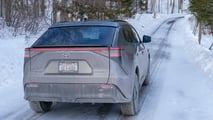
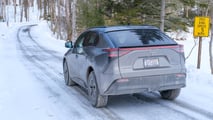
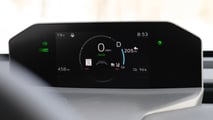
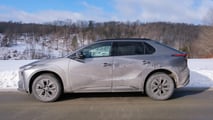
After a weeklong test, I can tell you the bZ is a better car and a better EV than the bZ4X ever was. But now one thing, instead of three things, holds it back—even though the ingredients are all there for Toyota to fix it for good.
[Full Disclosure: Toyota loaned me a 2026 bZ for a week of testing.]
2026 Toyota bZ: Specs And Features
I’ll give Toyota this: it’s certainly giving EVs a bigger shot right now than it did even a few years ago. 2026 brings significant updates to the Toyota/Lexus/Subaru electric family, as well as new members in different sizes. The cars all get updated batteries, better performance across the board, more range and improved charging speeds.
2026 Toyota bZ
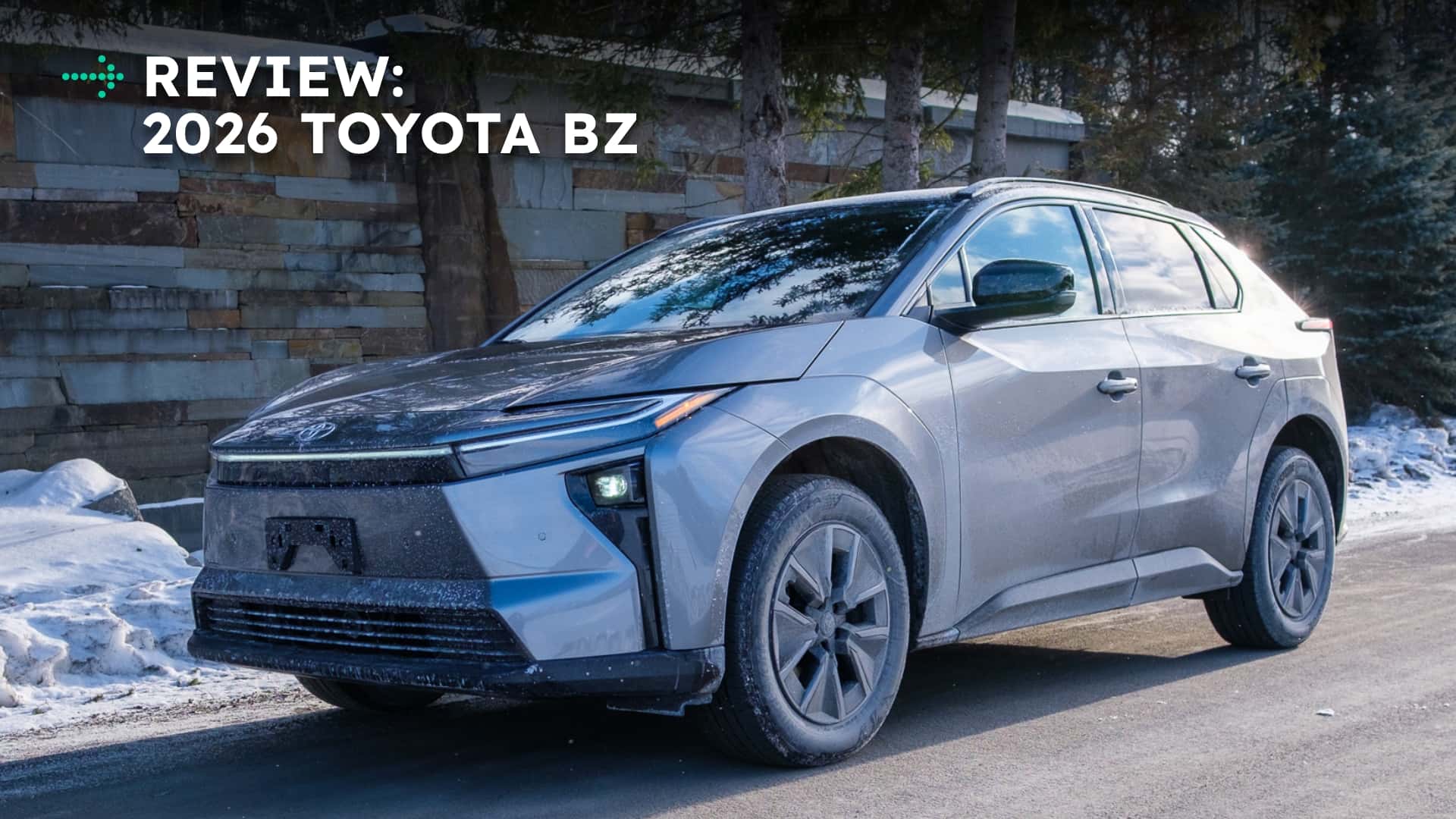
Of all of those new options, the bZ remains the all-rounder choice. It’s a compact-midsize crossover in the same price and size class as the Tesla Model Y, Hyundai Ioniq 5, Ford Mustang Mach-E, and others. It can be had in XLE and more well-appointed Limited trims. As before, the bZ comes in single-motor front- or dual-motor all-wheel-drive, and the overall styling is basically the same. But a lot is different under the skin.

The base bZ now gets a new, smaller 57.7-kilowatt-hour battery pack, but most models will use a 74.7-kWh unit—slightly bigger than what was in the bZ4X. Range stretches from a sub-par 235 miles in the XLE FWD model to an impressive 314 miles in the XLE FWD Plus model with the larger battery. That’s much more competitive across the board; the bZ4X topped out at just 252 miles of range. Updated electric motors deliver more power, too. The AWD models deliver 338 horsepower to the old car’s 214, and front-drive models get a 20 hp boost to 221 hp.
Perhaps most importantly, charging is improved, too. Gone is the old CCS port, replaced by a developed-in-house Tesla-style NACS unit. Maximum fast charging speed is still the same at 150 kilowatts—and still midpack by modern standards—but the charging curve has been improved. Unlike the O.G. bZ4X, this car can also fast charge multiple times in one day. Previously, that weakness kept the bZ4X from being a competent road-trip machine.
In my conversations with Toyota engineers, they made clear that they took to heart the feedback of bZ4X owners and would-be buyers—and that they don’t see any value in sitting out the global EV race. The result is a vastly improved car on paper, but that’s only part of the story.
2026 Toyota bZ: Driving Experience
My bZ tester was an XLE FWD Plus model with the bigger battery, but a modestly equipped one at that. It’s pretty fun to drive, just like the old bZ4X was. My tester weighed in at 4,057 pounds, making it almost a lightweight by EV crossover standards. That, coupled with a finely tuned chassis, gives the bZ a kind of agility and lightness that you don’t get with competitors from Chevy or even Hyundai and Kia. Engineers put real thought into how this car handles, and it shows on the road.
Still, I’m no great fan of the torque steer inherent to front-drive EVs. Based on my time in its sibling, the Subaru Solterra, I do recommend the AWD bZ instead unless you’re absolutely looking to maximize your range. It has better, more balanced driving dynamics and the extra power is quite welcome. Toyota claims the FWD bZ does 0 to 60 mph in eight seconds, but I’m convinced it’s quite a bit quicker than that. Like most EVs, it feels quicker than its on-paper performance figures suggest.
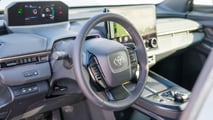
Besides losing the “4X” on the badge, this new car is nearly identical on the outside to the old one. It’s a different story inside. The center console has been revised to offer more space, the driver-facing display is in a new and more visible spot, the dashboard was completely redesigned and the area around the central display is now much less cluttered. It’s a subtle improvement, but a likeable one, and the bZ remains comfortable for long-distance driving—just still heavy on black plastics and a dark, industrial vibe.
On the plus side, the bZ is refreshingly easy to use. Normal, by EV standards. Those door handles? Nothing new here. They’re just door handles. Buttons and physical switches abound. It’s all very easy to figure out. At a time when the auto industry is reeling from the unintended consequences of cutting-edge design, the bZ’s RAV4-like controls are strangely welcome. If you want an EV that’s not fussy to operate from a physical control perspective, give this one a look.
You will sacrifice interior space to some rivals. You get 28 cubic feet of storage behind the second row of seats (or 26 cubic feet if you opt for JBL speakers) and 94.4 cubic feet of overall space, but no frunk. The bZ’s cousin, the new RAV4, has it absolutely trounced in terms of interior volume. Hyundai and Tesla’s EVs do much better on this front, too.
Overall, I still like driving the bZ. Maybe it’s the shark-like design, or the familiar yet humble badge, or the lack of a tech learning curve. But it just feels like a good, normal family crossover that happens to be electric, and I tend to vibe with that.
2026 Toyota bZ: Range, Efficiency And Charging
In ideal weather conditions, a bZ XLE FWD Plus like this one would be the distance king of the family at 314 miles of range. But we have not had ideal weather conditions in upstate New York this winter, and when I tested the bZ, the temperatures were sometimes in the negatives. Not great for EV performance, no matter which company built the car.
Still, the bZ saw range losses I’d consider normal for such conditions. A 100% charge sometimes meant 267 miles or about 245 miles. The car’s range is adjusted on the fly when you play with the climate system and as outside temperatures change. For efficiency, my tester went as high as 2.7 miles per kWh in the cold, about on par with my own Kia EV6 right now.
I didn’t get a chance to fast-charge the bZ during my test. But based on my tests of the updated Solterra and Lexus RZ, I have no reason to believe it won’t go from about 15% to 80% in about 25 minutes on a Tesla Supercharger. That’s a good 10 to 20 minutes better than various iterations of the bZ4X could achieve.
2026 Toyota bZ: Tech Features
Here’s where things start to fall down a bit. If you get a 2026 RAV4, you’re treated to Toyota’s new Arene connected software platform. It’s a total overhaul of the infotainment system and the software and hardware stack behind it. You get more customizable displays, better graphics, a faster and more intuitive interface, and a proper home screen with mapping, audio, and range displays. For a company that’s behind the curve on software, it’s quite good.
But the bZ (and the C-HR and bZ Woodland) are, for now at least, stuck with the previous software system. That means you’ll live with more rudimentary displays, you have to subscribe to use the “cloud navigation” system, and worst of all, there is still no EV route-planning. And if you need to find an EV charger, you have to do so with Toyota’s smartphone app. To the company’s credit, the app is now very good—features include remote starting and charging management. But it's ridiculous that the built-in navigation system is so limited. Want to navigate from New York City to Los Angeles? The bZ will tell you how to get there with the ETA of a gas car, because charging is on you to figure out.
A Toyota spokesperson couldn’t say why the bZ, CH-R and bZ Woodland don’t have Toyota’s latest software, but he confirmed the new Highlander will. “As always, we will listen to the voice of the customer to evaluate these features for future model years,” he said. That’s a sign of progress. But until it spreads across the board, I have a hard time recommending a new EV in 2026 without any sort of route-planning.
I’ve heard some owners defend this lack of a feature by saying they don’t road-trip often (which is also statistically true) or that they know where their plugs are (and certainly, so do I). But the problem is that for the same amount of money, you can get any number of EVs now that will help you find plugs and plan a long trip at the press of a button. And wouldn’t you want that instead?
Supposedly, the bZ has route-planning and range info through Apple Maps when you fire up Apple CarPlay. But I never got that to work. And even if I could, leaning on Apple for such a key function feels like a cop-out.
My sincere hope is that Toyota adds the Arene software to its family of EVs, and soon. At least the new Highlander EV has it, so that’s a sign of progress.
2026 Toyota bZ Vs. The Competition
The bZ brings style, solid range, usability and (presumably, anyway) Toyota’s renowned reliability to a very competitive segment. There’s the Model Y, the O.G., which is now better than ever but saddled with quite a bit of brand baggage.
Chevrolet’s Equinox EV and Blazer EV match the bZ on many specs, but have an Android Automotive OS-based software system that’s far superior to this one. The Hyundai and Kia EVs still have the bZ beat on fast-charging speeds. And while the Ford Mustang Mach-E is showing its age a bit, it can still hold its own and it’s even more fun to drive.
2026 Toyota bZ: Price and Verdict
To its credit, the bZ is also a better deal than its predecessor. It starts at $36,350 (including destination) for the entry-level XLE FWD trim. That’s more than $2,000 cheaper than the base bZ4X was. The XLE FWD Plus, like my tester, starts at $39,350. An XLE AWD goes for $41,350 and the loaded Limited will set you back $46,750. Again, competitive, but enough to make you mourn the $7,500 EV tax credit.
So, where does that leave the bZ now? Yes, it’s better than ever. But I’m struggling to tell you why to buy one, unless you can score an incredible deal or just really, really love buying from Toyota. And for many people, that badge alone is enough. If the bZ had route-planning and better software, it would be, too.
As of now, buying one means getting a decent-range EV from a trusted brand, but also some frustrating compromises. With any luck, a computer transplant from the RAV4 is in order. When that happens, maybe Toyota’s EV game can finally take off as it should have by now.
Click here to see all articles with lists of the best EVs