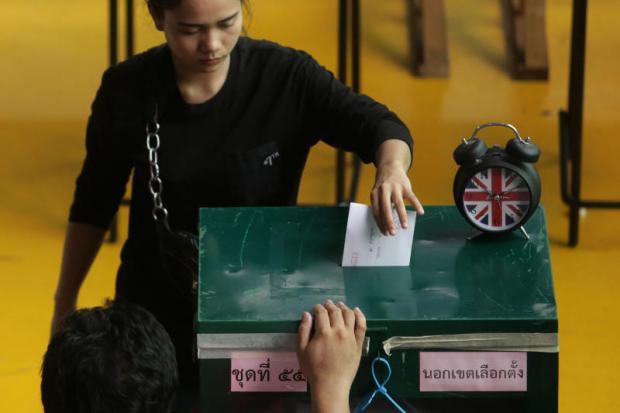
Elections are often a referendum on incumbencies. Voters are asked whether they like what they have seen from government and whether they want continuity or change in view of competing alternatives. In the same vein, Thailand's momentous election on March 24, after a nearly eight-year hiatus that includes almost five years under military-authoritarian rule, is an opportunity to see what the governed prefer to have as their government. Here are some of early telltale signs that portend the political directions ahead.
First and foremost, the government of Prime Minister Prayut Chan-o-cha, backed by the military junta he led in seizing power in May 2014, will be facing the Thai people's judgment. The junta has relied on a series of related arguments to rationalise its continuation in office. It has banked its legitimacy on a binary proposition between peace and order on the one hand and elections and instability on the other, between the junta and its coalition of conservative columns and competing forces aligned to ousted, self-exiled and convicted prime minister Thaksin Shinawatra.
In other words, voters are being ultimately asked to choose between strong and benevolent generals and squabbling and corrupt politicians, between Gen Prayut in Thailand and Thaksin in exile.
But this is a false dichotomy because military generals over the past decades have shown themselves no less prone to graft compared to elected politicians. The current regime has kept corruption seemingly manageable partly because military expenditures have been opaque and secretive, assisted by a coup-appointed rubber-stamp legislature. Shining a light on weapons procurements, government spending projects, nepotism on state enterprise boards, among other schemes, would likely yield some shady dealings.
In addition, Thailand is seeing a third way and a viable alternative in electoral politics for the first time in the 21st century. Political parties, such as Future Forward and Seri Ruam Thai, have been anti-junta and outside the Thaksin camp at the same time.
Unlike the 2007 and 2011 polls, the junta has organised its own electoral vehicles, led by the Palang Pracharath Party. The last time a junta-backed party contested a poll was in March 1992, when it won using army coercion, state budget, and bureaucratic machinery. Back then, political parties were weak, civil society strong, and the military virtually invincible. This time, Thaksin's parties appear resilient after three dissolutions, civil society is divided, with the army firmly in control.
Just hours away from the poll, the pro-junta parties should be doing much better, even on course for a landslide, but they are trying to emerge as the second-largest winning party and could end up third behind the Pheu Thai and Democrat parties. So the most immediate attention should be focused on how the incumbent regime fares, given all of the state's means and electoral advantages at its disposal.
The junta-led government also has tightened constitutional rules and electoral mechanisms in favour of appointees to assume the premiership and maintain control over parliament and the electoral landscape. If such a rigged system still fails to convincingly return Gen Prayut to power, then voters will be rejecting the junta-led conservative coalition thunderously and demonstrating their resolve and commitment to have a say.
Poll results are likely to take longer compared to 2001, 2005, 2007 and 2011, partly because voting time has been extended by an hour. Moreover, electoral rules are now more technical and petty, with ample room for interpretation and discretion from the Election Commission (EC). Along with the National-Anti Corruption Commission and the Constitutional Court, the EC also will be on trial in this election.
So far, it has undertaken decisions that seem uniformly supportive of the pro-junta, pro-Prayut parties and individuals. If these agencies, which used to be seen as "independent" in the late 1990s and first became politicised under Thaksin in 2005-06, become overtly partial, the electoral process and poll results will correspondingly lack credibility and legitimacy.
If early counting seems favourable towards the incumbent junta-led regime, then it is likely that indicative results may be announced sooner rather than later. If anti-junta parties do well and even better than expected, it would not be surprising if vote results take longer to announce.
Finally, the most promising poll outcome for Thailand's future may not be how many MPs this or that party garners, but how young these MPs are across parties.
In and outside of parliament, Thailand is a country that is run by mostly old men, with very few older women, at the top where power and politics really matter. Seeing the backs of this old generation has had to rely on the passage of time. Thailand has had to wait for these aged but powerful folk to fade away physically, if not always quietly.
It is a common joke among military generals that a better Thailand requires the riddance of all established and corrupt politicians to start with a new slate. Now, the time may have come for a critical mass of new, younger politicians are poised to run future Thailand.
Thus the demographic breakdown of the post-election MPs will be crucial. Instead of 55-plus years of age, a majority of these representatives could well be under 40. No matter which party they belong to, these younger MPs speak more sense among each other and with the electorate. If they rise, it will be their job to get rid of not just old-style civilian politicians but also same-old power-grabbing generals.
Thitinan Pongsudhirak teaches at the Faculty of Political Science and directs the Institute of Security and International Studies at Chulalongkorn University.