Rival for the Honda CR-V can help the country’s leading brand expand its SUV lineup and further justify its investment in hybrid electric vehicles.

They should have sold it ages ago!
When Toyota broke ground with the market’s first compact SUV in the 1990s, the Thai office brought it over to Thai showrooms in imported form.
But after import duties were jacked up in 1997 due to the Asian financial crisis, sales ceased ever since to make way for the more cost-effective Sport Rider, which eventually morphed into today’s Fortuner.
In the meantime, rivals have been rolling out car-based SUVs for years which now includes the Honda CR-V, Mazda CX-5, MG GS and Nissan X-Trail. All of them stood out over pickup-based SUVs with more car-like dimensions and road manners.
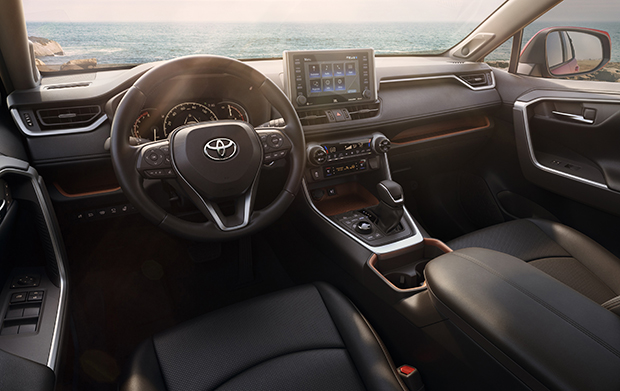
According to sources at Toyota Motor Thailand, official sales of the RAV4 in fifth-generation form are now being evaluated to steal some action from this particular corner of the SUV market.
The all-new RAV4 was first launched in the US last year and has just been introduced in Singapore this month.

It should nicely fit into the local lineup of Toyota’s SUVs…
People at Toyota say that many potential customers of the B-segment C-HR love the styling and hybrid powertrain of the vehicle but have been turned off by the claustrophobic rear accommodation.
The C-segment RAV4 could answer the needs of this particular set of buyers because it has a reasonably spacious cabin for the family. Moreover, the RAV4 isn't as cumbersome to drive as the Fortuner and boasts hybrid economy for the daily grind.
The latest RAV4 uses the same TNGA platform and petrol engines as in the Camry. The 2.5-litre petrol-electric hybrid, for one, can compete with the X-Trail Hybrid, which currently goes for 1.3-1.5 million baht. A part-electric version of the CR-V is available elsewhere but not in Thailand.
The launch of the RAV4 in Thailand could be considered as timely since more new models are set to join the scene like the Chevrolet Blazer (new Captiva) and MG HS (indirectly replacing the GS).
Although the RAV4 would be positioned in a similar price range with the Fortuner, a couple of rival brands have managed to sell both kinds of SUVs in Thailand like Chevrolet with its Captiva and Trailblazer and Nissan with X-Trail and Terra.
It seems like Toyota wants more hybrids in Thailand…
As the Board of Investment is now giving out special privileges to local carmakers churning out vehicles with some sort of electrification, Toyota is keen to offer as many hybrid-powered cars as possible in the country
While the Fortuner faces 20% excise tax, the RAV4 can attract just 4% in hybrid form emitting no more 100g/km of CO2. That’s currently the case for the Camry and C-HR HVs.
More crucially, the RAV4 has a better basis to evolve into plug-in hybrid and battery electric vehicles in the future. The Fortuner lives off diesel engines and the more archaic chassis-on-frame structure from the Hilux Revo pickup workhorse.
For some time already, Toyota has a plan to lift Thai assembly facilities with higher-technology products. Capacity for the RAV4 would be possible since some production of the Fortuner could be shifted to Indonesia, where the Avanza, Innova and Sienta MPVs are currently made and shipped to Thailand via Afta trade perks.