Introduction
All modern websites are expected to do much more than display the information. Users expect to have fast-loading pages, smooth navigation, and an interface that works well on every device.
Creating this experience requires having structured tools. Frontend frameworks help developers to build the visual part of a website in a more organized way. They provide ready-to-use components, reusable code, and a clear development structure.
Instead of writing every feature from the beginning, developers can use these frameworks to build a user interface faster. This also helps to maintain consistency across the different pages of a website or a web application.
Today, many businesses rely on modern frameworks when building scalable web platforms. The right framework can improve development speed, maintainability, and overall performance.
This article explains some of the best front-end frameworks used in web development. It will also help you understand how to choose the right framework for your project.
What is a Frontend Framework?
Frontend frameworks are basically a set of tools and pre-written code that is used to build the visual of a website or a web application. This helps developers to design the layout, create interactive elements, and manage how users interact with the interface of a website or web app.
Apart from writing the code of every feature, frontend frameworks allow the use of ready-made components such as buttons, navigation menus, and grids. This saves time on development and also keeps the code organized.
Frontend frameworks also provide a structure for managing the user interface. When multiple developers work on the same project, this structure helps to maintain consistency across the application.
For example, imagine that you are building an online dashboard for a business. Without frameworks, you need to prepare code for every layout and added component. But when you work with frontend frameworks, many of these elements are already available, and you can reuse them across your website in different pages.
This approach allows the development team to build a modern and responsive web interface more efficiently.
Why Frontend Frameworks Are Important in Modern Web Development
Building a modern website requires more than just a basic design and coding. It needs more of the interactive features, dynamic content, and even a responsive layout for all screen sizes. Frontend frameworks help developers manage these requirements in a structured way.
Frontend frameworks simplify the process of development and make it easier to build a reliable interface for a website. This also allows it to work faster and maintain a better quality of code.
Here are reasons why frontend frameworks are important:
Faster Development
Frontend frameworks include reusable components and ready-to-use libraries, which allow developers to build websites and applications in less time.
Better User Experience
Frameworks support responsive design and a smooth user experience. Websites built with these tools adapt well to the different screen sizes. This improves the usability across mobile devices and desktops.
Code Reusability
Developers can reuse the component across multiple pages and features. This reduces repetitive coding and keeps the projects more organized.
Easier Project Maintenance
Frameworks follow the structured coding patterns. This makes it easier for development teams to manage the updates and fix the issues. When a project grows, a structured codebase helps to maintain stability and performance.
These advantages explain why businesses often rely on a professional Frontend development company when building a modern web platform that requires reliability and scalability.
Best Frontend Frameworks for Web Development
Frontend frameworks help developers to build structured and interactive web interfaces. Each framework offers different strengths depending on the type of project and development requirements.
Some frameworks focus on flexibility, while others provide a complete development environment. Understanding these differences helps businesses choose the right technology for their web projects.
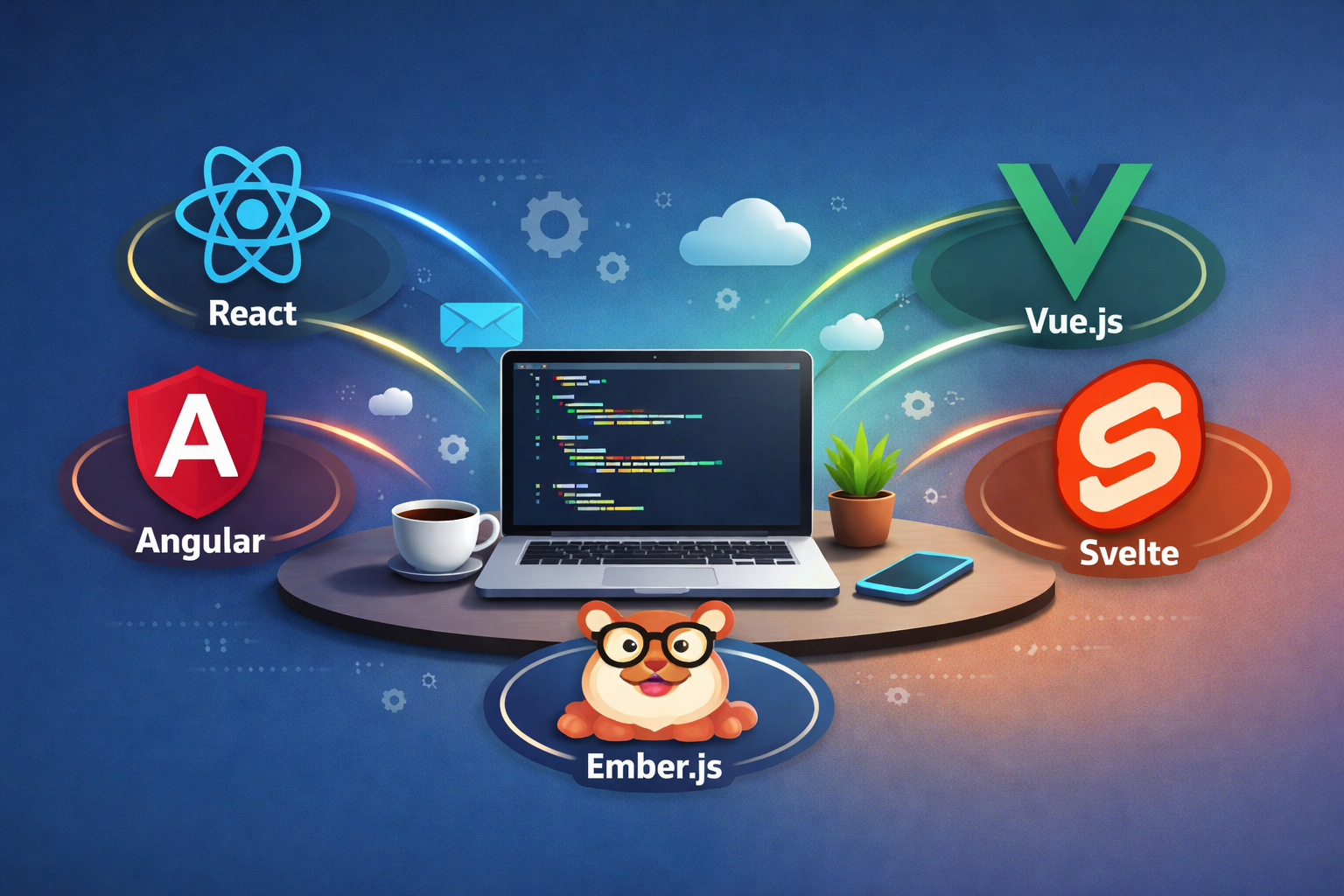
Below are some of the most widely used frontend frameworks in modern web development.
1. React
React is one of the most popular technologies used to build an interactive user interface. It was developed by Meta Platforms and is widely used for modern web applications.
React specifically focuses on building an application with the use of reusable components. Developers can create small UI components and combine them to build a complex interface.
Key features:
- Component-based architecture
- Virtual DOM for faster updates
- Strong ecosystem of libraries
- Large developer community
Common use cases:
- Single-page application
- Interactive dashboards
- Social media platforms
- Large-scale web applications
Many companies, such as Netflix and Airbnb, use React to build scalable web applications.
2. Angular
Angular is also a full-scale frontend framework, which is developed by Google. It is widely used for building large and structured web applications.
Angular provides the complete development environment. It includes the built-in tools for routing, form management, and data handling. This makes it suitable for projects that require strong architecture and long-term scalability.
Angular also uses TypeScript as its main programming language. This further helps developers to detect errors early and maintain better code quality.
Key features:
- Complete framework with built-in development tools
- Strong support for TypeScript
- Structured architecture for large applications
- Dependency injection for better code management
Common use cases:
- Enterprise-level web applications
- Large business platforms
- Complex dashboards and admin panels
- Applications that require long-term scalability
Many enterprise organizations choose Angular when they need long-term scalability and strict development standards.
3. Vue.js
Vue.js is known for its simplicity and flexibility. The framework was created by Evan You and has gained more popularity among developers.
Vue is often appreciated for its gentle learning curve. Developers can quickly start building an application without dealing with complex configurations.
Another advantage of Vue is its reactive data binding system. When the application data changes, the user interface updates automatically.
Key features:
- Simple and easy to learn structure
- Reactive data binding
- Flexible integration with existing projects
- Lightweight framework with strong performance
Common use cases:
- Startup web applications
- Interactive user interfaces
- Progressing web applications
- A project that requires fast development
Because of its simplicity, Vue is often chosen by startups and small development teams that need fast implementation.
4. Svelte
Svelt follows a different approach compared to many traditional frameworks. Instead of running in the browser, Svelte compiles components into efficient JavaScript during the build process.
This approach reduces the amount of code sent to the browser. As a result, applications built with Svelte often load faster and perform efficiently.
Developers also appreciate its clean syntax and simple state management system.
Key features:
- Compile-time optimization
- Smaller application bundle size
- Faster rendering performance
- Simple and readable syntax
Common use cases:
- Performance-focused web applications
- Lightweight web projects
- Interactive interfaces
- Applications that require minimal runtime overhead
Developers who prioritize performance and minimal overhead often consider Svelte for modern applications.
5. Bootstrap
Bootstrap is one of the most widely used frameworks for building responsive websites. It was originally created by engineers at Twitter.
Bootstrap focuses mainly on design and layout. It provides ready-to-use UI components and a grid system that help developers to build responsive pages quickly.
Because of its simplicity, Bootstrap is commonly used for rapid web development.
Key features:
- Mobile-first responsive grid system
- Large collection of ready-to-use UI components
- Easy integration with other frameworks
- Extensive documentation and community support
Common use cases:
- Business websites
- Landing pages
- Admin dashboards
- Rapid prototyping projects
Bootstrap is widely used for business websites, admin dashboards, and rapid development projects.
How Businesses Choose the Right Frontend Framework
Selecting the right framework is not only about making a technical decision. Businesses must evaluate how the frameworks fit their project goals, development resources, and long-term plans.
A framework reviews several factors before making the final choice.
Project Size and Complexity
The size of the project plays a major role in selecting the framework.
For example:
- Small websites or landing pages may work well with lightweight frameworks.
- Medium-sized applications may require flexible frameworks that support scalability.
- Large enterprise platforms often need structured frameworks with built-in tools.
A framework should match the complexity of the application.
Development Team Expertise
The skills of the development team also influence the decision.
If developers already have experience with a specific framework, development becomes faster and more efficient.
Many businesses prefer working with a professional Frontend development company that has experience with multiple frameworks and can recommend the most suitable technology for the project.
Performance Requirements
Performance becomes important when an application handles a large amount of user activity.
Companies usually evaluate factors such as:
- Page load speed
- Rendering performance
- Application responsiveness
- Ability to handle real-time updates
Frameworks that optimize the UI updates help to maintain smooth user experiences.
Community Support and Ecosystem
A strong developer community provides long-term advantages.
Popular frameworks often offer:
- Better documentation
- Regular updates
- Large plugin and library ecosystems
- Faster problem-solving through community forums
Frameworks with active communities usually remain stable and reliable for long-term development.
Emerging Trends in Frontend Development
Frontend development continues to change as user expectations grow and web technologies improve. Developers are focusing on faster performance, better user interfaces, and more efficient development workflows.
Several trends are shaping how modern web applications are built.
Component Driven Development
Many frameworks now follow a component-based approach. Developers build small interface components and reuse them across different parts of an application.
Benefits include:
- Better code organization
- Faster development
- Consistent use of interface design
- Easier updates and maintenance
This approach is widely used in frameworks such as React and Vue.js.
Server-Side Rendering
Server-side rendering is gaining attention because it improves both performance and search visibility.
In this approach, web pages are generated on the server before being sent to the browser.
Advantages include:
- Faster page loading
- Better performance on slower devices
- Improved search engine indexing
- Enhanced user experiences
Performance Focused Frameworks
Developers are now paying closer attention to application performance. Frameworks that produce smaller JavaScript bundles and faster rendering are becoming more popular.
For example, Svelte focuses on compile-time optimization to reduce the amount of code running in the browser.
Integration with Modern Development Tools
Frontend frameworks work closely with modern development tools and workflows.
These tools help developers manage projects more efficiently.
Examples include:
- Automated testing tools
- Continuous integration systems
- Build optimization tools
- Deployment automation platforms
These trends show that frontend development is moving towards faster, more efficient, and scalable web applications.
Conclusion
Frontend frameworks have become an important part of modern web development. They help developers to build structured, interactive, and responsive web interfaces by reducing the development time.
Frameworks such as React, Angular, and Vue.js offer different strengths depending on the requirements of the project. Some frameworks are ideal for enterprise platforms, while others work better with flexible and fast development.
Choosing the right framework depends on several factors. Businesses need to consider project complexity, performance requirements, and the expertise of the development team before making a decision.
For those who are planning to build scalable and user-friendly web applications, working with experienced professionals can make the development process more efficient. Many organizations choose to hire frontend developers USA to ensure their web projects are built using the most suitable frameworks and development practices.