

Valued at a market cap of $32 billion, Qnity Electronics, Inc. (Q) provides advanced materials and solutions for the semiconductor manufacturing and electronic systems industries. The Wilmington, Delaware-based company develops and supplies high-performance products critical to next-generation artificial intelligence, advanced connectivity, and high-performance computing architectures.
This tech company has notably outperformed the broader market over the past six months. Shares of Q have soared 99.7% over this time frame, while the broader S&P 500 Index ($SPX) has gained 12.2%. Moreover, over the past three months, the stock is up 33.4%, compared to SPX’s 7.2% rise.
Zooming in further, Q has also notably outperformed the State Street Technology Select Sector SPDR Fund (XLK), which soared 29.6% over the past six months and 25.6% on a three-month basis.
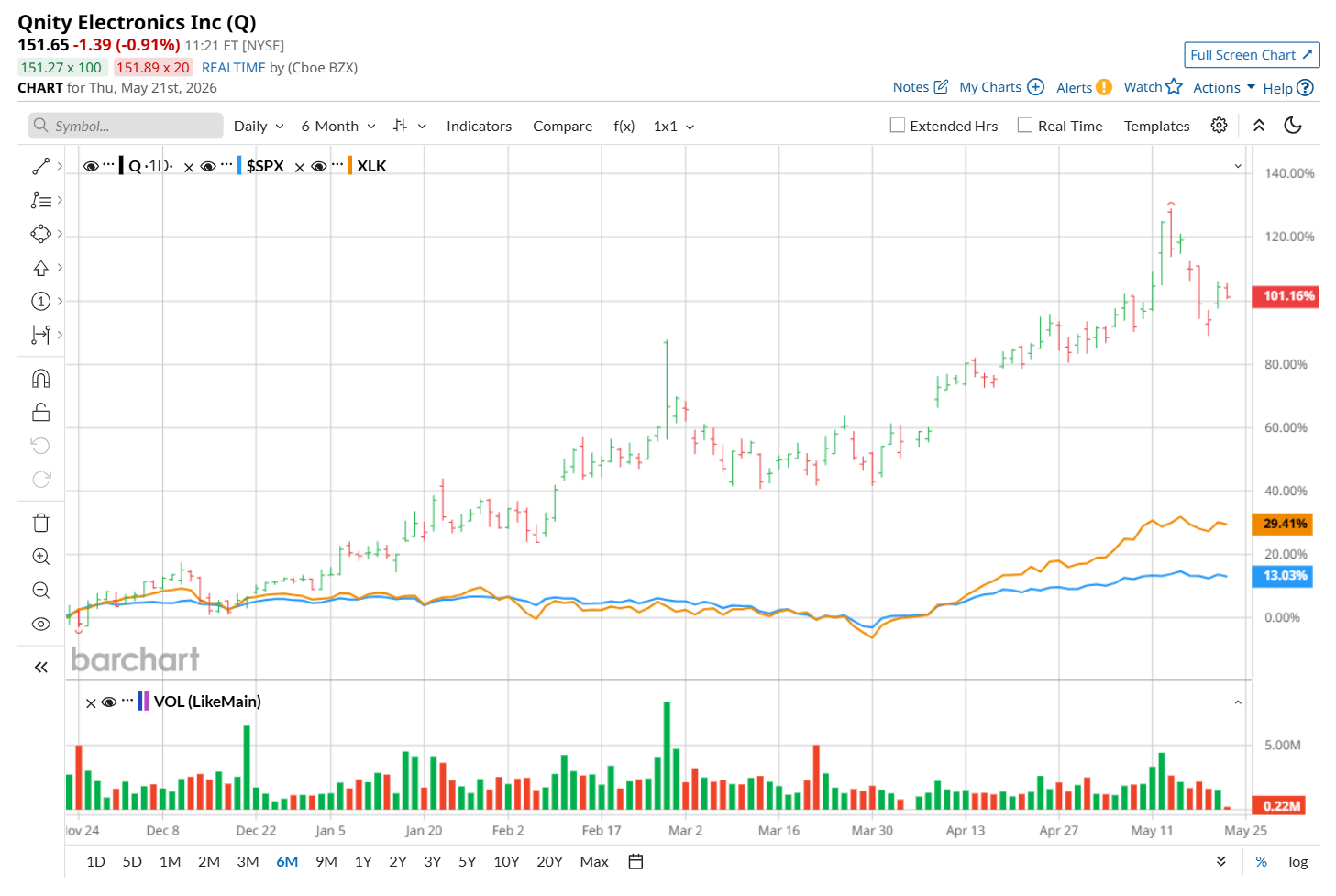
On May 12, shares of Q surged 9.9% after the company reported strong Q1 results, marking its eighth consecutive quarter of profitable organic growth with double-digit expansion across both business segments. Its net sales rose 17.6% year-over-year to $1.3 billion, while adjusted EPS climbed 33.3% from the prior-year quarter to $1.08, reflecting continued operational momentum and solid execution.
For the current fiscal year, ending in December, analysts expect Q’s EPS to grow 21.8% year over year to $4.08. The company’s earnings surprise history is promising. It exceeded the consensus estimates in each of the last three quarters.
Among the eight analysts covering the stock, the consensus rating is a "Strong Buy," which is based on six “Strong Buy,” one “Moderate Buy,” and one "Hold” ratings.
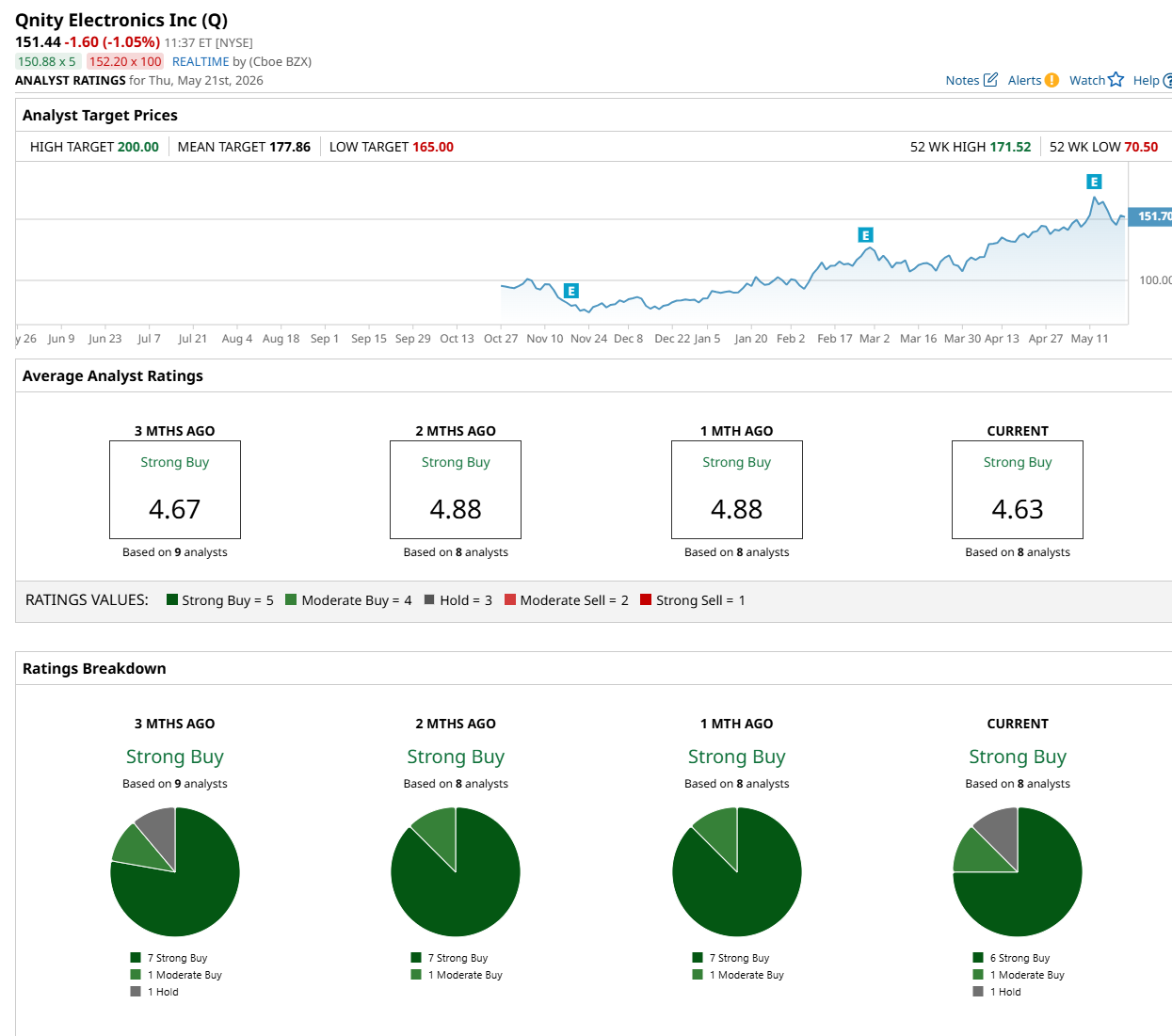
The configuration is less bullish than a month ago, with seven analysts suggesting a “Strong Buy” rating.
On May 13, Goldman Sachs maintained a “Buy” rating on Q and raised its price target to $165, indicating a 9% potential upside from the current levels.
The mean price target of $177.86 suggests a 17.4% premium to its current price levels, while its Street-high price target of $200 implies a 32.1% potential upside.