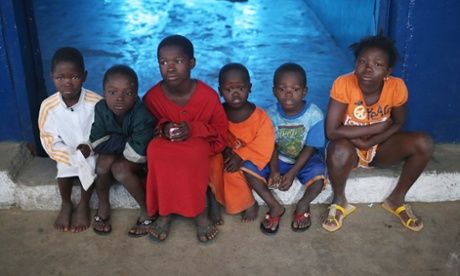
Australia needs to set up emergency protocols for the quick adoption of children from overseas who have been orphaned by Ebola, west African community leaders say.
Strict adoption laws in Australia mean family members here cannot legally adopt those orphaned by Ebola in line with traditional family obligations.
“I believe that there is a strong need … to have children affected by Ebola to be adopted,” said Edward Solo, from the federation of African community councils of Australia.
Solo lost five family members to the disease and now campaigns to mobilise Australians in the fight against Ebola.
He wants adoption treated like the humanitarian program, saying “the responsive need has to be put into this process”.
“There are a good number of members of the community who want to adopt children,” he said.
West African countries are struggling to deal with the approximately 11,000 children orphaned or abandoned by the deadly Ebola outbreak.
No adoption provisions exist between Australia and Liberia, Sierra Leone or Guinea – the three worst Ebola-affected countries.
Deborra-Lee Furness, an adoption advocate and nominee for this year’s Australian of the year, said expediting adoptions from in-need countries was difficult but should not be put in the “too-hard basket”.
“There are thousands of children in need,” she said.
Fewer domestic and international adoptions were finalised last financial year than in any other year since records began.
Australia’s complex adoption laws mean authorities have to establish individual bilateral relationships with governments before overseas adoptions can occur, to avoid child trafficking and exploitation. Very few such bilateral relationships exist, causing families to wait up to five years for a child.
The federal government has introduced measures intended to simplify the complicated adoption process. They include the formation of a multi-department agency that takes in representatives from prime minister and cabinet, immigration, foreign affairs, social services and the attorney general’s departments.
John O’Neill, from Adopt Change, said “emergency resourcing is needed to put in checks and balances” for adopting during times of crises, such as after natural disasters.
“In times of crisis you need a flexible system,” he said.
He said expediting the process for Australian families seeking to adopt from in-need countries would benefit both parties.
“It’s gobsmacking that the system we have now is so broken,” he said.
Orphans in Ebola-affected countries are often stigmatised and shunned by their families.
“While reactions from communities do vary, in many cases Ebola survivors and children who have lost parents are facing stigma from their communities out of fear and misunderstanding about the disease and how it’s spread,” a child protection officer from Save the Children, Amy Richmond, said.
“Families are too scared to take in children whose parents have died in case they bring the virus to their own families.” Save the Children do not support the policy of overseas adoption for children affected by Ebola.
Local authorities are struggling to cope. Poor infrastructure and a lack of government services in the impoverished communities of west Africa mean the bulk of caregiving responsibilities falls on individuals.
A Liberian healthcare worker, Elizabeth Moses, who works for the charity Médecins Sans Frontières as a frontline Ebola nurse, was moved by the plight of the orphans she encountered.
She turned her modest home in Monrovia into an orphanage and houses 23 children between the ages of 6 months and 17 years.
“These children really need care,” she said. “The majority of them are already survivors.
“I cannot take them all. I don’t have much, but at least I can give what I have.”





.jpg?w=600)