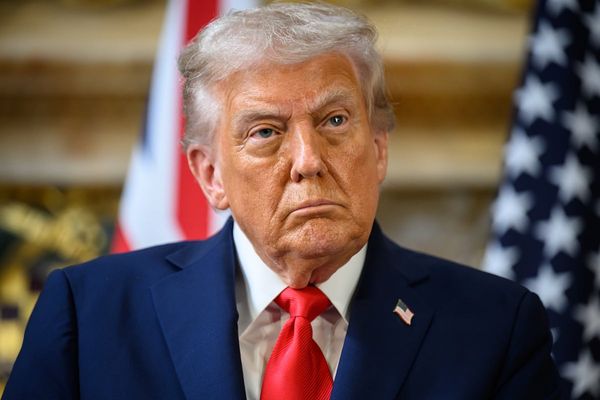
NEW YORK — Michael Cohen claimed in a new lawsuit Monday that his three-year prison sentence should be trimmed by nearly a year thanks to criminal justice reform signed into law by the man he betrayed: President Donald Trump.
Cohen says rehabilitation programs he completed while locked up at Otisville Federal Correctional Institution warrant a sentence reduction of 359 days under the First Step Act signed by Trump in 2018 and credit for good behavior. Cohen, acting as his own attorney, asks a Manhattan federal judge to reverse the Bureau of Prisons’ decision to deny credit for those programs. He argues in a second suit that other inmates are subjected to the same bureaucratic bungling.
“There are 153,248 current federal inmates. When I am successful in these two writs, requiring the Bureau of Prisons to do what they are required to do under the First Step Act, there could be potential earned time credit benefits to each of the above identified inmates, myself included,” Cohen told the New York Daily News.
A key component of the First Step Act is an assessment of an inmate’s likelihood of committing another crime. Cohen says he followed the letter of the law and received “low-risk” assessments unlocking reductions of his sentence after entering the dormitory-style prison camp for white-collar criminals. He participated in classes such as Drug Education: Freedom from Drugs, Health/Fitness, Victim Impact and Business Startup.
His sentence, Cohen argues, should be completed by May 29, 2021. The Bureau of Prisons wrote Cohen last week he will receive no credit off his sentence, according to the suit.
Cohen is serving the remainder of his sentence at home due to the risk of catching coronavirus behind bars. He pleaded guilty to nine crimes, including campaign finance violations, lying to Congress and dodging taxes.
Trump touted the First Step Act on the 2020 campaign trial while falsely boasting, “I’ve done more for Black Americans than anybody with the possible exception of Abraham Lincoln.”
Cohen’s lawsuit notes the act was “the result of a bipartisan legislative effort to moderately overhaul the criminal justice system.”
— New York Daily News
PHILADELPHIA — Even as President Donald Trump refuses to concede to President-elect Joe Biden and continues to falsely claim the election was rigged against him, other Republican White House aspirants are quietly starting to look ahead to the 2024 race.
Or, in the case of former New Jersey Gov. Chris Christie, perhaps not so quietly.
Christie on Monday signaled his interest in a potential 2024 campaign during an interview with conservative radio host Hugh Hewitt, suggesting even another Trump campaign wouldn't necessarily keep Christie out of the race.
"If President Trump decides to run in 2024, are you ruling out running against him?" Hewitt asked.
"I would not. No," Christie said, adding: "I would not rule it out, Hugh."
Later in the interview, Hewitt asked Christie if he'd already reserved a "Christie2024″ domain.
Christie noted that he already controls ChrisChristie.com. "So we're going to keep that one," he said, "and we'll see where we go from here, Hugh."
Politicians, of course, rarely rule out a potential run for higher office. But Christie has stayed in the public eye over the last four years, appearing regularly on TV as an analyst for ABC News, counseling Trump as an outside adviser, and now starring in a national advertising campaign urging people to wear face masks after his own bout with COVID-19. Christie contracted the disease and was hospitalized after spending time in the White House this fall without wearing a mask. He told Hewitt that he now feels "100%."
Christie is also a co-chair of Georgia Battleground Fund, a political group helping to raise money for Republican Sens. Kelly Loeffler and David Perdue in their runoff elections next month, which will determine control of the Senate.
During his 2016 campaign for president, Christie ran as a brash truth-teller, but he couldn't keep pace with the widely known reality television star who had even less of a filter. In 2024, Trump will turn 78; Christie will be 62.
— The Philadelphia Inquirer
ST. LOUIS – Missouri police agencies remain slow to sign up for an FBI program that tracks police shootings, nearly two years after its launch.
The National Use-of-Force Data Collection gathers information on fatal and nonfatal shootings and also records instances when officers fire their weapons but no one is struck. Experts say collecting this data is essential to understanding how officers make life-and-death decisions.
At least seven people have died in St. Louis-area police shootings in 2020, including Mark Brewer, a 28-year-old burglary suspect who was shot and killed on Dec. 6 by a St. Louis officer.
Participation in the FBI's program is voluntary. The area's two largest departments — St. Louis city and county — began submitting incident reports within the past year, but few others across the state have signed up. As of November, only 21 out of about 600 agencies in Missouri have participated, up from 13 in 2019, and they represent at least 26% of sworn officers in the state, according to the FBI.
Other local police departments that had enrolled as of August include Ballwin, Brentwood, Clayton, Creve Coeur, Frontenac, Ladue, Rock Hill, Sullivan and Webster Groves.
Enrollment in Illinois is higher: 55 out of 983 agencies are contributing incident reports, representing at least 47% of officers. The only area agencies participating in Illinois are Mount Olive and Trenton.
Police shootings continue to elicit strong reactions locally and across the U.S. The killing of George Floyd in Minneapolis on Memorial Day led to marches and protests, including a violent night in downtown St. Louis during which four officers were shot.
Collecting and sharing data on the use of deadly force is something police can do, like accreditation, to show the public they have nothing to hide, said Webster Groves police Capt. Stephen Spear, whose department began participating in the FBI's program in January.
"We strive to present ourselves as a professional, open and transparent agency," Spear said.
Webster Groves is a community that typically sees few use-of-force incidents. This year it has reviewed only 11, Spear said, compared with 337 total arrests. But one of those was deadly: In May, an officer exchanged gunfire with 23-year-old Qavon Webb on Interstate 44. Webb was killed and the officer was wounded.
Spear said he plans to submit a report on the shooting to the FBI's use-of-force program once St. Louis County police complete their investigation, which has been underway for seven months.
— St. Louis Post-Dispatch




.jpg?w=600)