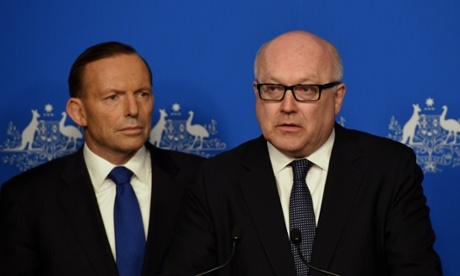
George Brandis privately warned Tony Abbott that politicising the debate over the Coalition’s controversial metadata legislation was “playing with fire” because the government needed Labor’s support to pass it.
The attorney general delivered the blunt message in a recent cabinet meeting, Guardian Australia has learned.
It came after a letter from the prime minister to the opposition leader, Bill Shorten, which was leaked to the Australian, demanded rapid passage of the laws. Shorten’s angry response accused Abbott of politicising the subject, ignoring legitimate concerns and possibly jeopardising bipartisan support.
In Abbott’s letter, sent on 22 January, he said the Lindt cafe siege and the Charlie Hebdo shootings in Paris “underscored the urgency” of the new laws and warned intelligence agencies were “going blind” because telecommunications companies were keeping data for shorter times.
He said the government wanted the bill passed on 19 March, having reluctantly agreed to an investigation by the parliamentary joint committee on intelligence and security, which reports on Friday.
In his reply, dated 9 February and also given to the media, Shorten wrote: “I am disappointed that recent media briefing has sought to politicise the development and consideration of anti-terrorism legislation … This is at odds with a responsible and bipartisan approach to such important issues.”
After the exchange of letters, and the warning from the minister responsible for negotiating the legislation’s passage, Abbott enlisted the support of the child protection campaigner and Bravehearts founder Hetty Johnston for the passage of the legislation because of metadata’s role in tracking perpetrators of child abuse. He said it was needed to avoid “unilateral disarmament in the face of criminals”.
Johnston said in a doorstop last week with the prime minister on the Gold Coast: “I understand they are looking for bipartisan support for this bill and hopefully they can obtain that.”
Abbott also raised the issue at a joint media conference alongside the Australian federal police commissioner, Andrew Colvin, in Melbourne.
The prime minister also raised the data retention laws during Monday’s national security address, again arguing for its rapid passage.
The joint committee has not yet reached a unanimous position, and bipartisan agreement is not yet assured. The committee met until late on Monday and is due to meet on Tuesday. Among the critical safeguards and restrictions not yet agreed is how the new laws affect journalists. It is understood the committee is debating legislated restrictions on access to journalists’ metadata, rather than a ban, but the detail has not been agreed.
The new laws are designed to prevent the erosion of metadata available to law enforcers over time as telecommunications companies keep it for shorter periods, and also to ensure all Australian companies keep the data.
The new requirement – that Australian telephone and internet companies keep metadata for two years for warrantless access by law enforcers – is to be phased in over two years, which Labor says gives the lie to the idea that there would be immediate “unilateral disarmament” or a significant detriment to investigations of terrorism or child abuse if time was allowed for negotiation and debate.
Law enforcers accessed metadata more than 500,000 times last financial year.
The joint committee on intelligence and security usually issues agreed reports. Other issues raised by Labor are the costs of the new requirements to retain data and who should bear them. The government has not yet quantified the cost.
An alliance of media organisations has said the laws could have a “chilling” effect on journalism.
The Greens senator Scott Ludlam has called it a proposal “with open-ended costs and unknown consequences, fast-tracked to distract away from the prime minister’s terminal leadership”.
“Tony Abbott wants the parliament to write a blank cheque for mass surveillance,” Ludlam said.
Brandis’s office has been contacted for comment.