That is all for tonight, I reckon. Thanks as ever. We’ll be back tomorrow. GW
Despite the rising tensions, Tsipras is still smiling tonight:
Άκουσε για βήμα μπροστά της Ελλάδας, και άρχισε τους πανηγυρισμούς ο @atsipras ... #ert #Tsipras #Greece pic.twitter.com/J5NUBjjjbt
— Ιάκωβος_Ι. (@iakovos_i) June 11, 2015
Finance minister Varoufakis is also at the ERT bash:
Συγγνωμη ο Βαρουφακης γτ πηγε στην #ert με το πυζαμακι του? pic.twitter.com/XMGUfAnxLf
— Αλ-αουχ-αντρο (@AlexandrosFL350) June 11, 2015
Alexis Tsipras is back in Athens tonight, and unwinding at public broadcaster ERT, which reopened today.
PM Tsipras at ERT relaunch party #Greece pic.twitter.com/AgH3FwtY05
— Derek Gatopoulos (@dgatopoulos) June 11, 2015

Video: the IMF announcement
Here’s a video clip from the IMF’s press briefing today, where top spokesman Gerry Rice dropped the bombshell news that the Fund’s negotiators are heading back to Washington.
Updated
Our economics editor Larry Elliott sums up the state of play this evening, as only Larry can:
“You’ve got to ask yourself one question. Do I feel lucky? Well, do ya, punk?” The lines spoken by Clint Eastwood in Dirty Harry sprang to mind when the International Monetary Fund (IMF) announced that it had called its Greek negotiating team home from talks in Brussels.
The IMF’s message was short and brutal. There were still major differences between Greece and its creditors. There was no progress in narrowing those differences. The two sides were well away from an agreement.
So much, then, for the talk earlier this week that a deal is close. Shares across Europe surged on hopes that a resolution to the crisis was at hand, but that optimism was punctured by the news from Washington.
The IMF, clearly, has had enough. It was unimpressed by Greece’s decision to bundle up all four of the debt repayments due this month and is frustrated by the unwillingness of Alexis Tsipras, the Greek prime minister, to cross its two “red line” issues – pensions and labour-market reform.
This, then, is the IMF holding the gun to Alexis Tsipras’s head. It feels like a pivotal moment, the point where the creditors are saying “take it or leave it” and the Greeks have to decide whether the IMF really means it....
Here’s his full analysis: IMF to Alexis Tsipras: ‘Do you feel lucky, punk?’
Anti-austerity protesters are demonstrating outside the Greek parliament in Athens tonight.
The march has been organised by the Communist-affiliated trade union PAME, whose supporters took over the finance ministry this morning.
It’s a reminder that Alexis Tsipras will faces opposition at home if he agrees to the tax rises and pension reforms demanded by lenders:


After a bruising day, Greece has been shown some support, by Brazilian President Dilma Rousseff.
Rousseff attended this week’s EU-Latin American Summit in Brussels, where she met Alexis Tsipras this morning. And speaking afterwards, the left-winger warned that creditors can drive a country into bankruptcy if they are too demanding.

Rousseff said (via AFP):
“The Greek prime minister spoke about his difficulties, which are public and well known. We know it’s tough -- we had to wait 20 years for growth,” .
“All austerity measures involve two sides, and one side imposes a measure which the country implements until they go bankrupt. We think of the example of Argentina at the end of the 1990s.”
Argentina famously defaulted on its debts at the end of 2001, after an IMF-led bailout and austerity package had led to a deep recession. It is still fighting investors who hold legacy debt, and who insist on being repaid in full.

Brazil's Rousseff sympathises with 'tough' times for Greece's Tsipras, at Brussels summit https://t.co/1sw95BG04n @AFP
— Danny Kemp (@dannyctkemp) June 11, 2015
IMF team got a break after being stuck in a Brussels hotel for 2 weeks w/o much to do, sources say. @MartinGreive @jandams @andretauber
— Olaf Gersemann (@OlafGersemann) June 11, 2015
Another twist tonight....Valdis Dombrovskis, European Commissioner for the Euro, has declared that a deal can still be reached.
Even though the IMF have hauled their officials back to Washington, Dombrovskis believes that Greece and her lenders still have time.
Speaking in Madrid, Dombrovskis told reporters:
“Negotiations are continuing on a technical level,”
“Progress is possible and (an) agreement is possible. It really requires political will.”
And ‘political will’ is a coded way of telling Alexis Tsipras to offer a proposal that its creditors can accept.
Dombrovskis was speaking alongside Spain’s economy minister Luis De Guindos; he also offered an optimistic view:
#Spain EconMin De Guindos: Room for flexibility on a Greek deal; proposals for #Greece are not ultimatum. /via @livesquawk #euro
— Yannis Koutsomitis (@YanniKouts) June 11, 2015
Full story: IMF leaves Greek bailout talks
If you’re just tuning in, here’s our news story explaining the latest dramatic developments around Greece’s bailout negotiations:
Updated
IMF negotiators leave Brussels, after a non-meeting of minds with Greece. More deadlines loom http://t.co/RYVHy3PS2N pic.twitter.com/feoaJWY8D1
— The Economist (@TheEconomist) June 11, 2015
The IMF’s withdrawal has come as a rather nasty shock to Greece, where optimism had been building that a compromise might be close.
Media reports are calling the move a “megaton bomb” dropped on Athens by its creditors.
And Helena Smith reports that you can already hear the cries of demonstrators denouncing the “new memorandum” (bailout agreement) wafting through central Athens, as tonight’s protests get underway.
As we covered earlier, communist protestors have already occupied the finance ministry this morning, in a show of defiance against further austerity measures.
Get serious and we’ll come back. That’s the message from the IMF tonight....
#IMF will return to Brussels once #Greece's gov't is ready to engage in serious talks, official says. @jandams @MartinGreive @andretauber
— Olaf Gersemann (@OlafGersemann) June 11, 2015
Greece: we're ready to intensify our efforts
Over in Athens the government spokesman has just announced that the Greek negotiating team is “ready” to intensify efforts to wrap up a deal “even in the next 24 hours.”
They add:
“For that reason it will continue to work on the unresolved issues such as the fiscal and debt sustainability.”
(via Helena Smith)
Is this a sign that Greece is caving in, and has got the message from Europe and the IMF?
Although the Fund has left the field, the Euro Working Group will be holding a informal meeting in Bratislava, the capital of Slovakia tomorrow. They’ll be preparing for next week’s eurogroup meeting of finance minister.
Updated
The IMF’s decision to pull its officials out of the talks with Greece has alarmed seasoned eurozone crisis watchers.
With Greece’s bailout expiring in under three weeks, it feels like creditors’ patience has expired, with just a few days to resolve the crisis:
Brussels negotiations between Greece, IMF and Eurozone collapse without agmt. Everyone's gone home. Feeling more like we're in endgame now.
— James Mates (@jamesmatesitv) June 11, 2015
The IMF is really pissed. #Greece pic.twitter.com/J8I35ZyPI2
— Mathieu von Rohr (@mathieuvonrohr) June 11, 2015
So much for those claims that Germany was ready to compromise....
The Financial Times has learned that Berlin has been warning this week that they wouldn’t be willing to make concessions to Athens; last week’s deal is the best on offer.
Here’s the story:
Greece’s bailout creditors signal that talks over aid are at an end
And here’s a flavour:
The German government has privately been sending signals in recent days intimating that it was time to cut off talks and adopt a harder-line, “take it or leave it” approach to the talks.
According to three senior eurozone officials, German leaders have told other eurozone capitals they are no longer willing to negotiate beyond a compromise deal presented to Mr Tsipras last week by Mr Juncker on behalf of Greece’s creditors.
Officials said Mr Tsipras’ strident rejection of the proposal before the Greek parliament on Friday, coupled by his governments attempt to renegotiate budget surplus targets that creditors thought they had agreed to, has hardened Berlin’s stance.
“The only answer they’re looking for from the Greeks is to say ‘yes’, said one eurozone official.
Have we finally come to "take it or leave it"? It certainly appears that way. @FT on #IMF & #EU warnings to #Greece http://t.co/YDXadFXAC8
— Peter Spiegel (@SpiegelPeter) June 11, 2015
Greek talks are in last-chance saloon
EU officials are briefing that the meeting between Tsipras and Juncker today was a final throw of the dice to get a deal agreed.
One diplomatic explained to Reuters:
“If the process was working properly the president would not have had to have a meeting with Tsipras today. President Juncker made a last attempt to make a deal possible.”
Traders in Athens must be biting through their pens in anger -- the IMF statement hit the wires just after the Greek stock market closed, having surged by 8%!
I fear it’s going to tumble back tomorrow...
Stock markets hit by IMF withdrawal
European stock markets had been surging ahead today, with the German DAX up another 1.5%.
But the news that the IMF’s negotiators are heading home has sent shares sliding:
Dax loses ground after #IMF says #Greece talks stopped. pic.twitter.com/upPvd92w6J
— Holger Zschaepitz (@Schuldensuehner) June 11, 2015
#IMF has major differences with #Greece...and European stocks do this.... pic.twitter.com/NYzHD4cKRU
— Mark Barton (@markbartontv) June 11, 2015
IMF withdraws team from Brussels, criticises Greece
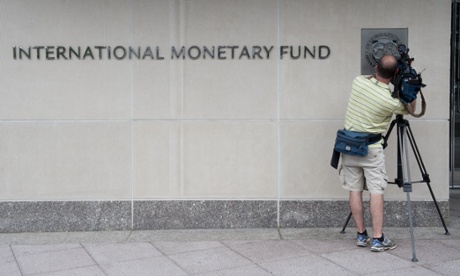
Serious news from Washington. The International Monetary Fund has announced that its negotiating team in Brussels is heading home!
Spokesman Gerry Rice has just told reporters that there are still “major differences” between the IMF and Greece on key issues, including pension reforms and tax rates.
Bloomberg has the story:
The IMF said that its team negotiating with Greece has left Brussels after failing to make progress on a debt deal that would help the country to avoid default.
“The ball is very much in Greece’s court,” International Monetary Fund spokesman Gerry Rice told reporters at a media briefing in Washington on Thursday. “There are major differences between us in most key areas. There has been no progress in narrowing these differences recently,” he said.
The IMF’s decision to withdraw its team comes amid increasingly sharp criticism from creditors at the Greek government’s continued refusal to bow to their demands, risking a default and ultimately an exit from the euro common currency.
IMF Managing Director Christine Lagarde will attend a meeting of euro-area finance ministers in Luxembourg on June 18, Rice said.
“As our managing director has said many times, the IMF never leaves the table,” he said.
Another sign that creditors are losing patience with Greece.
The FT’s Peter Spiegel has read between the lines of Juncker’s comments -- he has told Tsipras that it’s time to get that deal sorted.
Left unsaid in @JunckerEU's focus on process in meeting w/@atsipras: Top-level talks are spent. Time to strike deal based on last wk's plan
— Peter Spiegel (@SpiegelPeter) June 11, 2015
That echoes Donald Tusk’s warning at lunchtime -- that the time for talking is over.
Juncker and Tsipras agree to stay in 'close contact'
Just seeing some quotes from Jean-Claude Juncker too!
He says today’s meeting with Alexis Tsipras was “Important, Interesting and Friendly”.
The Commission president also reveals that he explained a possible process which Tsipras could pursue to reach a mutually acceptable deal in time. The two leaders will stay in “close contact” over the coming days, Juncker added.
Does that mean we could see a deal early next week, in time for the Eurogroup meeting on the June 18th?
Two-hour meeting between @atsipras & @JunckerEU has wrapped. Talk focused on process: how to get a deal done with the "institutions" #Greece
— Peter Spiegel (@SpiegelPeter) June 11, 2015
Updated
Alexis Tsipras has spoken briefly to a reporter has he left his meeting with Juncker.
The Greek PM said he is seeking a deal that means Greece’s debts will be “viable” in future, while also guaranteeing social cohesion.
That’s similar to his statement last night, after meeting Merkel and Hollande.
Seems like @atsipras replied to a question while exiting the building. No greek journo was there though..
— Eleni Varvitsiotis (@Elbarbie) June 11, 2015
The @atsipras said more or less the same with yesterday's statement but in English this time
— Eleni Varvitsiotis (@Elbarbie) June 11, 2015
Reporters in Brussels say that Alexis Tsipras’s meeting with Jean-Claude Juncker has now ended, after around two hours....
Meeting btw @JunckerEU and @atsipras is over. No statements.@euronews @euronewsgr
— EfiKoutsokosta (@Efkouts) June 11, 2015
One regular blog reader, James Wilkins, emails some thoughts on Donald Tusk’s comments from Greece’s second city, Thessaloniki:
Am still not sure that Greeks will accept more bullying. Sitting here trying to work, with the sunlight streaming through the windows, it seems unreal that foreign powers think they have the right to rob ordinary Greeks of almost everything except the sunlight. I have followed this crisis first hand and often in this blog. To begin with it was with a feeling of dismay, then disbelief and now with fury....and I am not Greek!
What gambling does Tusk refer to? Whether Greeks should hold out for a second crust of bread or be content with one? Does the future of the Eurozone depend on that?
The Greek stock market is hitting new highs, up 8% now as optimism builds....
The Tsipras-Juncker meeting is now underway. Let’s see if it produces the progress that Donald Tusk is demanding...
.@JunckerEU meets with Prime Minister of Greece @atsipras pic.twitter.com/UwI8dpPGzJ
— Natasha Bertaud (@NatashaBertaud) June 11, 2015
Donald Tusk: No more Greek gambling, we need decisions
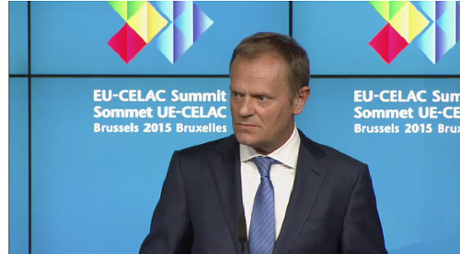
Donald Tusk, the president of the European Council, has intervened in the Greek bailout crisis by declaring that Europe needs to see a deal now.
Unless an agreement comes imminently, there is a risk that someone will decide enough is enough next week, Turk warned, in a pointed signal to prime minister Alexis Tsipras.
Speaking at the closing press conference for the EU-Latin America and Caribbean Summit, Tusk says that there is no more time for gambling, or negotiations. Now is the time to decide.
“It is very obvious that we need decisions, not negotiations.”
“There is no more time for gambling. The day is coming, I’m afraid, that someone says that the game is over.”
Next week’s eurogroup meeting, on 18 June, is really crucial, Tusk added.
Upcoming #Eurogrοup meeting is really crucial and should be decisive - says @eucopresident #Tusk #Greece
— EfiKoutsokosta (@Efkouts) June 11, 2015
That eurogroup meeting is the next opportunity for eurozone finance ministers to sign off any Greek deal. From the look on Tusk’s face, he’ll be furious if the opportunity is missed.
Brussels experts agree that it’s a powerful and unusual move from Tusk.
EU's Tusk comes out strong on Greece: 'no more time for gambling'
— Danny Kemp (@dannyctkemp) June 11, 2015
Rare @DonaldTusk comments on #Greece: "We need decisions not negotiations now. The Greek government has to be a little more realistic."
— Peter Spiegel (@SpiegelPeter) June 11, 2015
As I type, Tsipras should be sitting down with Jean-Claude Juncker to discuss the crisis. Might Tusk’s intervention make a difference?...
Updated
Greek stock market jumps 7% on deal hopes
The Greek stock market is absolutely surging today as optimism sweeps the trading floors in Athens.
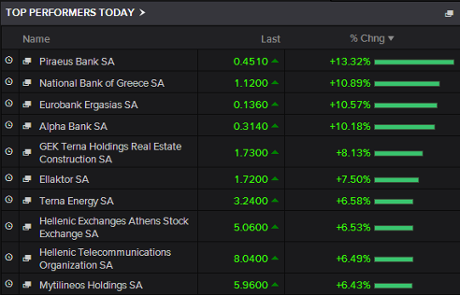
Bank shares are rocketing ahead, as investors anticipate progress in Brussels to unlock aid for Greece in time.
The main ATG index is up over 7%, on track for its best day since February. And bank share have rallied by as much as 17%:
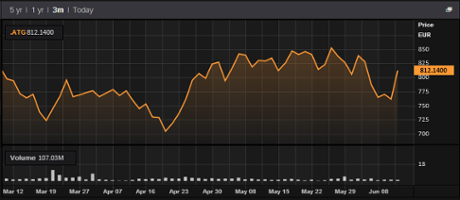
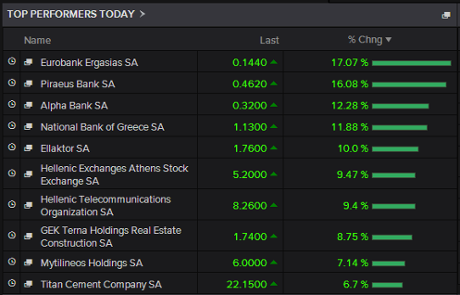
Yesterday’s report that Germany was prepared to allow Greece to stagger its reforms is clearly still boosting confidence.
And Bundesbank chief Jens Weidmann’s concerns about Greek insolvency risks may also be pushing shares up. As covered earlier, Weidmann warned that the contagion potentially caused by Greece shouldn’t be “underestimated”.
That could be a warning to those in Europe who believe Grexit is containable.
It’s quite a rally, given last night’s meeting between Tsipras, Merkel and Hollande didn’t deliver a deal; just a pledge that efforts will intensify.
As Brenda Kelly of London Capital Markets puts it:
It merely looks like talks have ‘intensified’ which ultimately leaves us exactly where we were and makes one wonder whether Greece will manage to fudge a deal at this point at all. There is no deal just an agreement that a viable solution needs to be found.
Updated
Greek minister: Deal would mean higher taxes
Greece’s national economy minister Giorgos Stathakis has revealed that any new deal eventually carved out for debt-stricken Greece will include increased taxes.
That’s a first for a sitting politician representing the governing radical left Syriza.
Helena Smith reports
Speaking to state-run TV’s newly relaunched channel, ERT, Stathakis gave a glimpse of what Athens’ new agreement with creditors will entail for Greeks. The deal, he said, would give the green light to privatisations (once a red rag for the leftists) and emergency levies on mid-income salaries.
Publicly-owned assets put up for sale would range from the port of Piraeus to the railway network, TrainOSE and regional airports nationwide. An almost watertight blackout by negotiators on the workings of what in effect is expected to be a new financial lifeline for Greece, has spawned widespread speculation but little in the way of specifics.
The measures will mean prime minister Alexis Tsipras rolling back on seminal pre-election pledges. The leader is counting on his unrivalled popularity ratings and widespread support for his Syriza party to carry him through.
EcoMin Stathakis. Syriza officials appear on state TV panel for 1st time in 2 years after ERT relaunch #Greece pic.twitter.com/VzCC9fIzN0
— Derek Gatopoulos (@dgatopoulos) June 11, 2015
The news of the concessions were revealed as Greece’s council of state, the highest court in the land, announced that 800,000 pensioners had been wrongfully deprived of earnings when Athens’ former left-right government imposed cuts on pensions of employees in state-run utilities and the private sector back in 2012.
The lost earnings are estimated at as much as €1.5bn which the government will now have to find.
Stathakis was among a host of government ministers who spoke to ERT on the premier day of its relaunch exactly two years to the day after it was abruptly closed down. Prime minister Alexis Tsipras had made reinstatement of the channel - which had remorphed as Nerit in late 2013 - a major pre-election pledge.

Updated

A lot of Greek officials are locked out of the finance ministry today, as today’s anti-austerity protests continue.
Protestors currently occupying the building are exhorting passers-by to join tonight’s mass rally, which kicks off at 7.30pm local time.
On the first floor, one individual has a megaphone and is chanting:
“Enough of memoranda, new measures and poverty”
Jan Strupczewski, Reuters’ deputy bureau chief in Brussels, is hearing encouraging noises from EU officials.
He writes:
Greece and its creditors could reach a deal in their cash-for-reforms talks next week, in time for the next meeting of euro zone finance ministers, the Eurogroup, on June 18, a senior EU official told Reuters on Thursday.
Talks between Greece and the institutions -- the International Monetary Fund, the European Central Bank and the European Commission -- would continue on Thursday with a focus on Greek pension reforms, value added tax rates and primary surplus targets, officials familiar with the talks said.
“All that and more will be on the table. I don’t think there will be a breakthrough yet today, but I think there is a good chance that next week will bring an agreement that can be endorsed by the Eurogroup,” the senior official said.
Optimism appears in #Greece talks -- some officials see a good chance of a deal next week
— Jan Strupczewski (@reutersJanS) June 11, 2015
Newsflash from Brussels. Alexis Tsipras and Jean-Claude Juncker will meet at 1pm BST (2pm local time).
Tsipras meets juncker at 14.00 @la_stampa
— Marco Zatterin (@straneuropa) June 11, 2015
#Greek fin min digs in his heels: we will not accept 1% primary surplus, he says. Blames news blackout for lack of transparency in talks
— Helena Smith (@HelenaSmithGDN) June 11, 2015
Varoufakis: We won't accept 1% primary surplus
Greece has not, and will not, cave in over its creditors demand for a 1% primary budget surplus this year.
So says finance minister Yanis Varoufakis, in the Athens parliament a few minutes ago.
He told MPs that Greece is standing firm, even though these surplus targets are one crucial area of disagreement. Greece had originally proposed a surplus of just 0.6%, arguing that larger savings would be counter-productive, but then raised it to 0.75%
Varoufakis insisted that rumours that Greece might accept the 1% target, though, are wrong:
“We have not under any circumstances agreed to 1 percent for this year as it was reported.
This kind of approach is part of the problem and not the solution and we are not going to sign this.”
#Varoufakis says there's lack of transparency on what is being discussed in ongoing negotiations, lack of transparency not our choice
— Daphne Papadopoulou (@daphnenews) June 11, 2015
Greece also has a massive long-term unemployment problem:
910K, ~72% of the unemployed, have been out of work for more than 1 year #Greece pic.twitter.com/9mNbBAJjJP
— Yiannis Mouzakis (@YiannisMouzakis) June 11, 2015
Greek unemployment rate jumps
Greece’s unemployment rate has surged back up, in a grim reminder of how Greece’s economy has worsened this year as the bailout crisis has escalated.
The Greek jobless rate jumped to 26.6% in the first quarter of the year, up from 26.1% in October-December.
The number of people in work decreased by 0.9% compared with the previous quarter, while the unemployment total rose by 2.1%.
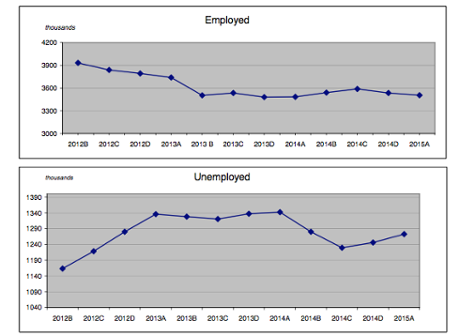
That’s not a shock, given Greece also lurched back into recession this year.
But it shows the perilous state of its economy now, with young people suffering particularly badly.
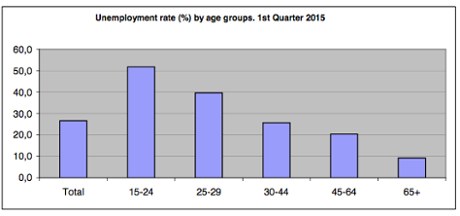
The unemployment rate among young Greek women is 57%. http://t.co/efihGblGWL
— Katie Martin (@katie_martin_fx) June 11, 2015
Updated
Alexis Tsipras has faced a tricky audience this morning – Finland’s new prime minister, Juha Sipilä.
Σε εξέλιξη συνάντηση με τον Πρωθυπουργό της Φινλανδίας κ. Juha Sipilä. #EUCELAC #Greece pic.twitter.com/NHgSVFnXNF
— PrimeMinisterGR (@PrimeministerGR) June 11, 2015
Sipilä’s coalition includes the eurosceptic True Finns party, who are opposed to any fresh help for Greece, and believe it should leave the euro.
Communists rallying against a radical left government. #onlyinGreece
— Yannis Koutsomitis (@YanniKouts) June 11, 2015
Greek communists hold strikes and rallies

Meanwhile, Greece is bracing for a series of strike rallies today by unions aligned with the country’s orthodox communist party KKE.
This morning’s protest at the finance ministry [see here for photos] are just the start, as the Pame union urges prime minister Tsipras not to sign up for a new bailout:
From Athens, Helena Smith reports.
Some 700 unions, associations and labour organisations will take to the streets in 59 towns across Greece today in the first big show of protest against the new loan agreement the Syriza-led government is hammering out with international creditors.
Rallies will be held in towns big and small, from north to south, on islands and the mainland, according to Pame, the party’s militant trade union.
A massive demonstration has been scheduled for 7:30pm (5.30pm BST) outside the finance ministry in Athens where streets are already emblazoned with billboards and posters urging people to participate.

This is the first major display of opposition to what hard left-wingers describe as another “memorandum” with all the onerous terms that every other bailout accord has carried for Greece.
The union said:
“The executive secretariat of Pame calls on all trade unions, labour organisations and working classes to respond en masse, combatively and decisively to the new memorandum that is being prepared by both the government and institutions (EU, IMF, ECB...)...
“[And] to take a fighting position against the new measures that are being prepared which will tear apart what little labour rights have remained.”
Updated
Bundesbank chief: Greek insolvency risks are rising.

Jens Weidmann, the head of Germany’s Bundesbank, has warned that the dangers of Greece going bust are increasing every day:
In a speech this morning, Weidmann warned that central banks risk being overburdened by the demands placed on them. He cites the emergency liquidity assistance which the ECB is providing as one example where monetary policy is being stretched:
It is clear that monetary policy can stimulate the economy in the short run. What it cannot do, however, is deliver sustainable growth. Metaphorically speaking, if you have a rowing boat and one of the oars is broken, it is better to try to fix that oar than to paddle with the remaining one.
Weidmann, one of the hawkish voices on the ECB’s governing council, warns that Greece’s people would suffer most if the crisis exploded.
But he also cautioned against believing that Grexit wouldn’t pose serious consequences.
There is a strong determination to help Greece improve its public administration, remove barriers to growth and put public finances on a sustainable path. And taxpayers from other euro-area countries have provided substantial funds to support the unavoidable adjustment processes. But time is running out, and the risk of insolvency is increasing by the day.
The contagion effects of such a scenario are certainly better contained than they were in the past, though they should not be underestimated. But the main losers in that scenario would be Greece and the Greek people.
What I would like to stress here is that an erosion of the principles of monetary union also has consequences for the Eurosystem and the monetary union that no one should downplay.
Weidmann uncharacteristically restained on #Greece this morning http://t.co/JotsO9f4kH
— Peter Spiegel (@SpiegelPeter) June 11, 2015
Updated
We have a winner:
@graemewearden @dannyctkemp 'To fetch the cow from the ice' is a German expression for resolving a difficult problem.
— Captain Europe (@captain_europe) June 11, 2015
A small prize for whoever can translate Jean-Claude Juncker’s words of wisdom:
'When a cow is on the ice you have to push it off' - Juncker on top cryptic form today ahead of talks with Greece's Tsipras
— Danny Kemp (@dannyctkemp) June 11, 2015
Merkel: Greece agreed to work intensively

Angela Merkel has told reporters that she, Francois Hollande and Alexis Tsipras agreed that Greece will work “intensively and with high pressure” in the days ahead, at last night’s talks.
Reuters has the details:
Greece told its European partners that it was committed to intense discussions with its creditors to solve all open issues and avoid a looming default at the end of the month, German Chancellor Angela Merkel said on Thursday.
“At the end of the talks there was absolute unanimity that Greece will work intensively and with high pressure with the three institutions in the coming days to solve all open issues,” Merkel told reporters after arriving for a meeting between EU and Latin American leaders.
Allianz’s chief economic adviser, Mohamed El-Erian, fears the Greek crisis could damage the European Central bank’s reputation and finances, given it is now providing €82bn of emergency support to Greece’s banks
FYI #S&P downgrade of #Greece to CCC has few consequences.It does highlight however extent of financial and reputational risk for @ECB #ELA
— Mohamed A. El-Erian (@elerianm) June 11, 2015
And speaking on Bloomberg TV, El-Erian warned that policymakers are “losing control of the situation on the ground”
Even if you come up with even another bandaid, this isn’t a problem that is going to be resolved any time soon.
Another busy morning for Alexis Tsipras.
He’s now held a meeting with the first vice-president of Cuba, Miguel Díaz-Canel, as the EU-Latin American summit continues.
Συνάντηση με τον πρώτο Αντιπρόεδρο της Κούβας, κ. Miguel Diaz-Canel. #EUCELAC #Greece pic.twitter.com/xkbBtZb8bb
— PrimeMinisterGR (@PrimeministerGR) June 11, 2015
Greek bank share are soaring ahead today, as optimism ripples through the Athens stock market:
Updated
You can keep track of all Greece’s debt repayments in the coming months, in our nifty tracker:
European stock markets are all up in early trading, led by the German DAX (0.7%).
Traders appear confident that some deal will be reached with Greece, despite the lack of clear signs of progress last night.

And the main Greek stock index has surged by 5.5% in early trading.
Athens investors are reacting to yesterday’s Bloomberg report that Germany was apparently open to a ‘staggered’ deal, in which Greece would receive funds if they agree one reform deal.
Updated
S&P: Greece's real deadline is July 20

Moritz Kraemer, chief rating officer of Standard & Poor’s, has also identified the €3.5bn ECB repayment on July 20 as the key date for Greece and its creditors.
Last night, Standard & Poor’s cut Greece’s credit rating by one notch to CCC, just two places above default, and warned that the country’s liquidity position continues to deteriorate.
Speaking on Bloomberg TV a few minute ago, Kraemer said that Greece wouldn’t officially default if it failed to repay the International Monetary Fund on June 30, as the IMF isn’t a commercial creditor.
However, failing to repay the European Central Bank would have very serious consequences..
The real deadline is in July when Greece must repay the money it owes to the ECB.
If they miss that payment, my expectation is it would be impossible for the ECB to continue providing emergency liquidity to the Greek banking sector.
But as flagged earlier, any deal could take several weeks to implement, before funds are handed over.
Yesterday, the ECB agreed to provide another €2.3bn of liquidity to Greece’s banks, to help them stay afloat.
But, Kraemer argues, the ECB might be forced to reassess the situation if it doesn’t get its own money back next month.
If you subtract all the Greek government debt that Greek banks hold, their solvency is questionable.
Updated
#Greece MP @tsipras back in da house: No comments on night talks with #Chancellor Merkel and F Pres. #Hollande when entering day 2 #EUCELAC
— Dirk Hoeren (@DirkHoeren) June 11, 2015
July 20th is emerging as the new hard deadline for Greece
That’s the date when it must return €3.5bn to the European Central Bank. And writing in the FT this morning, Peter Spiegel explains that officials fear serious trouble if the payment is missed:
Officials are hoping to reach an agreement by next week’s meeting of eurozone finance ministers to ensure the €7.2bn tranche can be disbursed before a €3.5bn Greek government bond comes due on July 20.
Eurozone officials believe it will take a month for Greece to legislate and implement the reform programme, and a default on the July 20 bond, held by the European Central Bank, could spark financial chaos in the country, officials believe.
Although Greece’s current bailout ends at the end of the month, a deal reached by next week could include a programme extension so that bailout tranches could be paid into July.
More here: Leaders fail to reach deal on Greek aid
Here’s more quotes from Pierre Moscovici’s interview this morning, via Reuters:
“Greece must make more efforts to provide a list of reforms so that their economy can be more solid and so that they can fulfill their commitments to their creditors.
“I am convinced that divergences have now been narrowed enough so that in the days to come we can intensify our work and reach the outcome we all want.”
Communists occupy the Athens finance ministry
Ructions in Athens this morning. Members of the Communist-affiliated PAME Union have occupied the finance ministry in an anti-austerity demonstration.
They’ve hung a huge banner on the building, showing Tsipras alongside his two predecessors - plus some menacing cigar-toting heavies representing the European Central Bank.


Moscovici: We must move to the "happy ending"

European Commissioner Pierre Moscovici hasn’t given up hopes of a breakthrough between Greece and creditors.
Speaking on RTL Radio, Moscovici urged negotiators to intensify the work.
“I really like Greek tragedy but now we must move to the happy ending”
Despite the months of deadlock, Moscovici reckons the splits can be resolved in time.
“We are close to the landing strip. There is political will, we can and must succeed.”
New day, same old song: EU's Moscovici says talks with #Greece must intensify in coming days.
— Holger Zschaepitz (@Schuldensuehner) June 11, 2015
Updated
The Agenda: More Greek talks in Brussels
Good morning, and welcome to our rolling coverage of the Greek bailout talks and other events across the world economy, the financial markets, the eurozone and business.
Just 20 days to go until Greece’s bailout expires, and we still don’t have a deal.
European leaders are gathering in Brussels again today, to conclude the EU-Latin American Summit, and Greek issues will surely be discussed on the sidelines again.
That will include another meeting between prime minister Alexis Tsipras and Commission president Jean-Claude Juncker. Tsipras is back at work already, meeting the leader of Brazil:
Meeting now with the President of Brazil, Ms. Dilma Roussef @dilmabr. #Greece pic.twitter.com/YhTkZ1lKpe
— Alexis Tsipras (@tsipras_eu) June 11, 2015
As we covered last last night (yawn), the leaders of Germany, France and Greece discussed the crisis for two hours last night. But rather than a big breakthough, they only agreed that talks must “intensify”.

Alexis Tsipras told reporters afterwards that:
“I think the EU leadership realises they must agree to a viable solution and a possibility for Greece to return to social cohesion with security and growth and also with a sustainable debt level.
This will not only give security to Greece, but Europe as well.”
So nothing to confirm, or deny, yesterday’s Bloomberg report that Germany could accept a staggered deal, in which Greece receives funds in return for a single big reform.
While the talks took place, rumours swirled that Greece was proposing a nine-month bailout extension, and that it might accept its creditors demand for a 1% budget surplus this year.
There was little clarity, though, on what economic measures it might take in return....
We’ll be tracking all the events through the day....