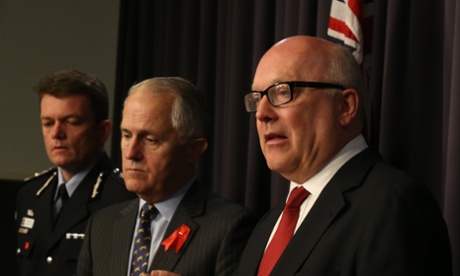
The attorney general will have to approve any prosecution of a journalist for reporting on special intelligence operations, a move George Brandis says is aimed at quashing the “entirely false story” that the government’s new security laws could lead to such prosecutions.
The concerns Brandis refers to have been expressed by every media organisation in Australia and the Law Council.
The attorney general said “almost all of that public commentary was wrong” and “it was a fanciful notion that anyone would be prosecuting journalists”.
“I’m concerned that so much discussion about those provisions ... is misguided,” he said.
“There is no possibility, no practical or foreseeable possibility that in our liberal democracy a journalist would ever be prosecuted for doing their job.”
He said he had instructed the commonwealth director of public prosecutions on Thursday that the DPP must obtain the consent of the attorney general if the director had a brief to consider prosecuting a journalist.
“That would mean that in the barely foreseeable, barely imaginable event that a journalist were the subject of a prosecution brief to the commonwealth DPP, the attorney general, as a political official, as a minister, would assume immediate responsibility for allowing that prosecution to proceed ... this would add a very powerful safeguard by providing that the attorney general would be required to consent to and therefore accept personal and political responsibility for a prosecution.”
Brandis conceded any future attorney general could overturn the directive.
Labor leader Bill Shorten said he was “not excited about having George Brandis deciding freedom of speech in this country ... offering to put on his Superman cape to be there as the last sentinel”.
On Wednesday night, Shorten wrote to the government to bring forward a review of the laws criminalising the reporting of special intelligence operations (SIOs).
Asked why he was asking for an early review of legislation his party recently supported in parliament, Shorten said it was “just to reassure people about what is, and what should be happening”.
“I think it is always wise for people to listen to the community ... politics is not a photo at a particular moment and everything stops there ... it is important that we bring the community with us on matters of national security,” Shorten said.
The laws allow for journalists to be jailed for either five or 10 years for disclosing a special intelligence operation.
Labor helped pass the laws earlier this month, but Shorten’s letter asked that they be reviewed by the body that oversees intelligence and security laws. Possible changes include the insertion of a public interest test.
“Since the passage of the legislation, a number of concerns about the potential impact of these laws on the media reporting of legitimate matters of public interest and importance have been raised with me,” he wrote, asking Tony Abbott to refer “the implementation and operation of the relevant provisions in the bill to the Independent National Security Legislation Monitor [INSLM] for review.”
He said the review should consider related legislation, including the Public Interest Disclosure Act, and report by the end of June.
“As we have both stated, there is no higher duty for a Parliament than ensuring the nation’s security and keeping the Australian people safe. It is essential that our security agencies have all the powers they need to keep Australians safe from the threat of terrorism and those engaged in protecting Australians receive bipartisan support. However, it is also important that, by legislating to address the terrorist threat, we do not ourselves destroy the very democratic freedoms that we are seeking to protect.”
The bill was amended after a parliamentary committee recommendation to confirm that a journalist or any other person could be prosecuted only if they “recklessly” published information on an SIO, but a separate amendment proposed by senator Nick Xenophon – to insert the statement that a court must take into account whether the disclosure was in the public interest when sentencing – was rejected.
Among those who have attacked the new provisions are News Corp co-chairman Lachlan Murdoch and the Law Council of Australia, and, after they passed, Shorten’s frontbench colleague Anthony Albanese.
Albanese did not speak out against the provisions during the recent parliamentary debate – the only Labor figure to do so was the West Australian backbench MP Melissa Parke.