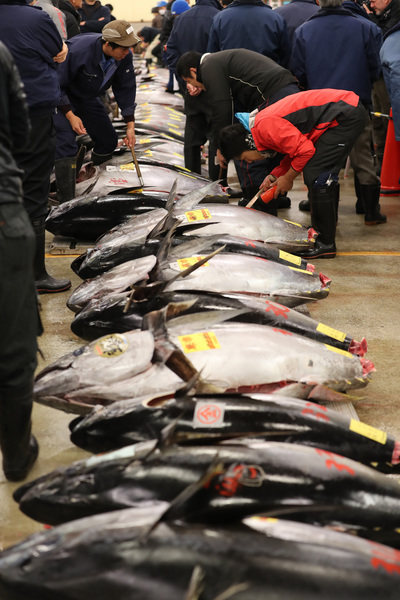
SAN DIEGO _ Federal fisheries managers rejected a petition to list Pacific bluefin tuna as endangered this week, concluding that the species is stable, despite its historic low numbers.
The National Marine Fisheries Service announced the decision Monday, stating that a team of fisheries and conservation biologists found bluefin at low risk of extinction.
It cited a 2016 international stock assessment that estimated the total population of Pacific bluefin at more than 1.6 million, including more than 140,000 fish capable of spawning.
"The Scientific Review Team found that the population is large enough to avoid the risks associated with a small population, such as a year with low survival, and that Pacific bluefin has recovered from similarly low levels in the past," the service stated.
The decision by the fisheries service, a branch of the National Oceanic and Atmospheric Administration, drew sharp rebuke from marine conservation experts, who said the species needs immediate protection.
"Today's decision by the National Oceanic and Atmospheric Administration not to consider listing Pacific bluefin tuna under the Endangered Species Act does not change the dire status of Pacific bluefin tuna, whose population has declined to just 2.6 percent of unfished levels," Margaret Spring, chief conservation officer for the Monterey Bay Aquarium wrote in a statement Monday. "Nor does this decision obviate the need for swift and meaningful international action to recover the population to a healthy level."
Bluefin can grow up to nearly 10 feet and 1,000 pounds, and migrate some 7,000 miles across the open ocean. All Pacific bluefin spawn in the western Pacific Ocean off Japan, but some migrate to the West Coast of the United States.
They're prized for their rich flavor, and considered one of the most challenging tuna to catch. Considered a delicacy among sushi chefs, they command high prices on Japanese markets.
That popularity has decimated the fishery, leaving Pacific bluefin at less than 3 percent of their historic numbers, according to recent stock assessments. Many of the fish are caught before reaching spawning age, and few young bluefin survive, creating a downward spiral for the population.
Fisheries managers have already reined in catch of the iconic sport fish. Federal rules reduced commercial catch of bluefin by 40 percent, and restricted the bag limit for West Coast sport fishermen from 10 to two bluefin per day.
Although the species faces threats including overfishing, prey depletion, marine pollution and climate change, the federal fisheries team concluded that existing protections should allow the population to stabilize or increase.