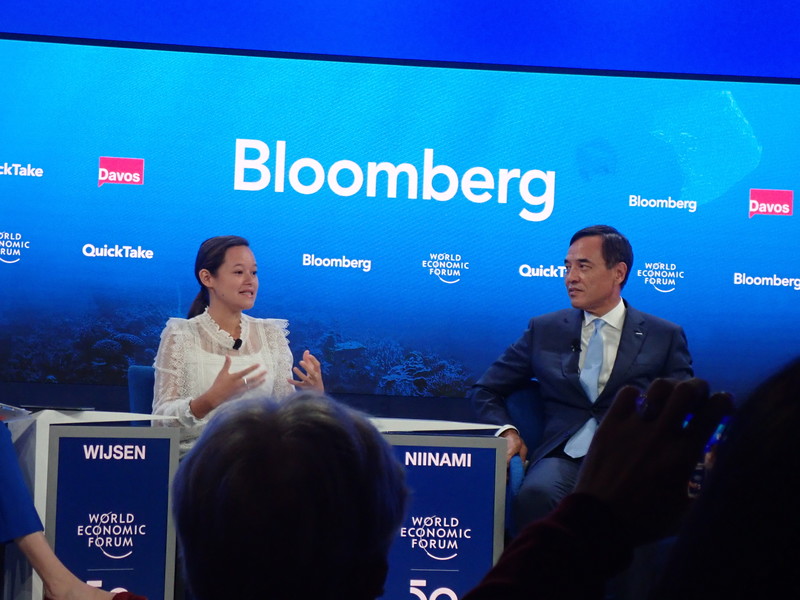
DAVOS, Switzerland -- On Jan. 24, the last day of the World Economic Forum Annual Meeting in Davos, Switzerland, a heated discussion over the use of plastic bottles and alternative materials took place among panelists at a session on the abolition of disposable plastic garbage.
The four panelists were former U.S. Vice President Al Gore; Akira Sakano, who is involved in the "Zero Waste" movement mainly in Kamikatsucho, Tokushima Prefecture; Takeshi Niinami, president of Suntory Holdings Ltd.; and Melati Wijsen, who led a campaign to prohibit the use of plastic shopping bags in Bali, Indonesia, at the age of 19.
When Niinami said: "I didn't say that I won't do that. I'll do it by all means. But this is the most suitable material now," Wijsen asked him just how long we had to wait for alternative materials.
During the heated debate in which Niinami and Wijsen refused to yield to each other's assertions, Gore soon supported Wijsen by shouting, "Go girl!" The venue was filled with loud laughter and applause. An active discussion continued in a bright atmosphere.
I didn't compare exact figures, but I had the impression that there were more sessions concerning Japan and Japanese panelists than last year. I think there were more than a few occasions on which Japan could make its presence felt.
During another session concerning Japan on Jan. 22, panelists included Hitachi Ltd. Chairman Hiroaki Nakanishi; Shinichi Kitaoka, president of the Japan International Cooperation Agency; former Australian Foreign Minister Julie Bishop; and Japanese artist Sputniko! They discussed a wide range of topics, including the rapidly aging and shrinking Japanese society, and Japan's role in the Indo-Pacific region, whose importance has been mounting.
Regarding women's active involvement in society, Sputniko! talked about a scandal in Japan in which scores of women seeking to go to medical school at universities had their entrance exam scores intentionally lowered and were discriminated against. Bishop reacted by saying in a frightening way that she would absolutely not allow such misconduct in Australia, which drew laughter at the venue.
I also noticed "Japan" at an unexpected location. There was a large sculpture characterized by its green color and curved lines near the front entrance of the main venue of the WEF international conference. The sculpture had a chair inside and resembled a small room. When I approached the sculpture, it gave off a nice smell. What? Was this kombu (dried kelp)? The sign said "Hidaka-Ohmu." I wondered what it was.
At the opposite side of the exhibition, kombu was lined up and a process for making brooches was being demonstrated in front of the kombu. When I asked Julia Lohmann, who created the sculpture, about its name, she said she named it "Hidaka-Ohmu" because she used Hidaka kombu (from Hokkaido) and that Ohmu came from a Ghibli film.
Lohmann said Ohmu refers to giant creatures that appeared in "Kaze no Tani no Naushika" (Nausicaa of the Valley of the Wind). She did not originally choose the name, but learned it after a friend who saw the sculpture during production told her that it was very similar to those large beings.
Lohmann said that when she saw the Ghibli film, she noticed that the great beasts protected nature and thought the name matched the intention behind the sculpture.
After I understood where the name came from, I felt much more comfortable in that room of kombu covered by the soft green color.
-- Hasegawa is a deputy managing editor of The Yomiuri Shimbun and the editor of the Yomiuri Shimbun Online website. Since joining The Yomiuri Shimbun in 1989, she has worked as a correspondent based in Manila, Geneva, Cairo and elsewhere. She took up her current posts in 2019 after working as editor and then managing editor of The Japan News. Her interests include diving and cooking. This is the second time she has attended the Davos conference; she also participated in 2019.
Read more from The Japan News at https://japannews.yomiuri.co.jp/