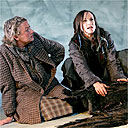
This was a new kind of West End first night: no B-list celebs, no braying backers, no phoney hysteria. But, much as I applaud the management's desire to expose Marina Carr's play to critics alongside a regular audience, I feel the work itself made infinitely more sense when I first saw it at the Dublin Abbey in 1998.
Bravely, if not always wisely, Carr has transplanted the story of Euripides's Medea to the bogs of rural Ireland. Her heroine, Hester Swayne, widely regarded as a "jezebel witch", is about to be jilted by her long-time lover, Carthage, so that he can marry a local landowner's daughter.
Warned to leave or die, Hester defiantly stays put, does her best to wreck her lover's wedding and engages in a fateful tussle over their bastard daughter.
In Euripides's play, Medea is like some natural force confronting a supposedly rational civilisation with its own brutality. But Carr's Hester, abandoned by her mother in childhood, seems more like a sad victim of circumstance than a mythic prototype.
And, in a modern context, naggingly literal questions arise. Since the tormented Hester has been driven by jealousy to fratricide, you wonder why she is walking around scot-free.
The irony is that when Carr trains her eye on the realities of rural Ireland, she writes superbly well. Much the best scene in the play is the hilarious wedding of Carthage to the submissive Caroline. As in Carr's earlier play, Portia Coughlan, I felt her real gift is for scathingly accurate observation of Irish life.
But the other problem with this production lies in the casting of Holly Hunter as Hester. Hunter is, without doubt, a real actress. Her Hester is a tiny bundle of muscular energy who occupies the stage.
She kicks the pay-off offered by Carthage's father derisively into touch. When reverting to liquor, she whips a bottle from inside her leggings and cups her hands over its base like a habitual toper. And, when asked by her daughter if she liked her mother, she shakes her head fiercely before poignantly replying "More than anythin' in this cold white world".
But acting skills can only take one so far: what I could never believe was that Hunter was a creature of the Irish bogs. Partly it's a matter of her tell-tale American vowels. But it's also a question of body-language. Where Olwen Fouere in the original Dublin production prowled warily around the stage as if reared in the unreliable soil of middle-Ireland, Hunter has her feet firmly planted on the ground.
Dominic Cooke's visually adroit production, with a curving bank of blood-stained snow designed by Hildegard Bechtler, in a sense highlights Hunter's isolation by surrounding her with a strong team of Irish actors. Brid Brennan is suitably forbidding as the fate-predicting blind Catwoman. Barbara Brennan is gutsily vulgar as Carthage's mother. Sorcha Cusack as a kindly neighbour, Patrick Waldron as the woozy priest and Kate Costello as Hester's daughter are also authentic.
But one is left with a play that in Dublin seemed to have visible roots in Irish culture. In London, it looks more like an exotic transplant. In Carr's play I felt that Hester could have made different choices. The result is a case-history rather than a poetic tragedy.
· Box Office: 0870 060 6633