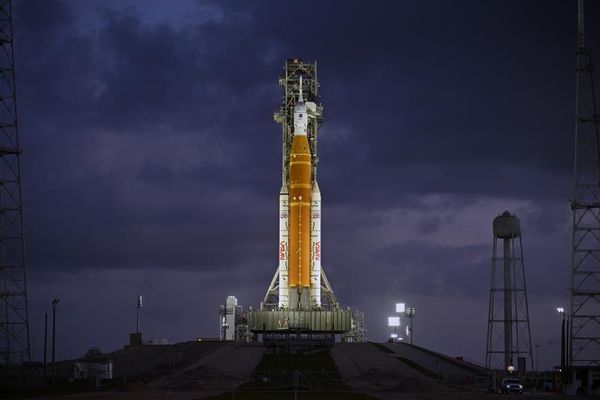

The US space organisation yesterday released its plan for establishing permanent settlements on the Red Planet, setting out in detail how it aims to create "deep-space habitation facilities" to act as stepping stones to Mars.
In a report entitled Journey to Mars, Nasa said the mission was a "historic pioneering endeavour" similar to the settlers in America and the Moon landing.
"Like the Apollo programme, we embark on this journey for all humanity," the report states. "Unlike Apollo, we will be going to stay.
"Efforts made today and in the next decade will lay the foundation for an Earth independent, sustained presence in deep space. Living and working in space require accepting risk and the journey is worth the risk."
 Video
Video
Nasa has divided the challenge of getting to Mars into three stages; Earth reliant, proving ground and Earth independent. The space agency is gathering information from experiments aboard the International Space Station, so that crews can live in deep space without health problems from radiation and the effects of micro-gravity.
The first experiments away from the ISS will take place in the area of space around the Moon, before missions begin venturing further afield. In the final step human missions will be sent into Mars's orbit or one of its moons, before crews land on the Martian surface and set up colonies using modular architecture and 3D printing.
 Video
Video
Nasa says it is designing "powerful transportation" system which will involve solar electric propulsion. Mars scientists will be following closely the upcoming Asteroid Redirect Mission, which seeks to use solar propulsion to bring an asteroid into lunar orbit where it can be studied.
Probes and robotic rovers such as Curiosity have been on or around Mars for 40 years and Nasa will continue to send new landers to gather information about the planet. Recent discoveries have shown that salt water which could sustain life is likely to be flowing on Mars. The remains of ancient lakes and river beds are also present.

Three steps to Mars: How colonies will be set up
• Earth reliant (2010s) - exploration focused on International Space Station testing technology and conducting human health and behavioural experiments.
Development of advanced communication systems and 3D printing.
• Proving ground (2020s) - establish a deep space base and begin a series of exploration missions to Mars. Develop supply chains to Mars.
• Earth Independent (2030s) - establish a long-term colony on Mars, harvesting planetary resources to create fuel, water, oxygen and building materials. 3D printing will be used in creating modular architecture.
Improve communication systems so there is only a 20 minute delay in contacting Earth.